
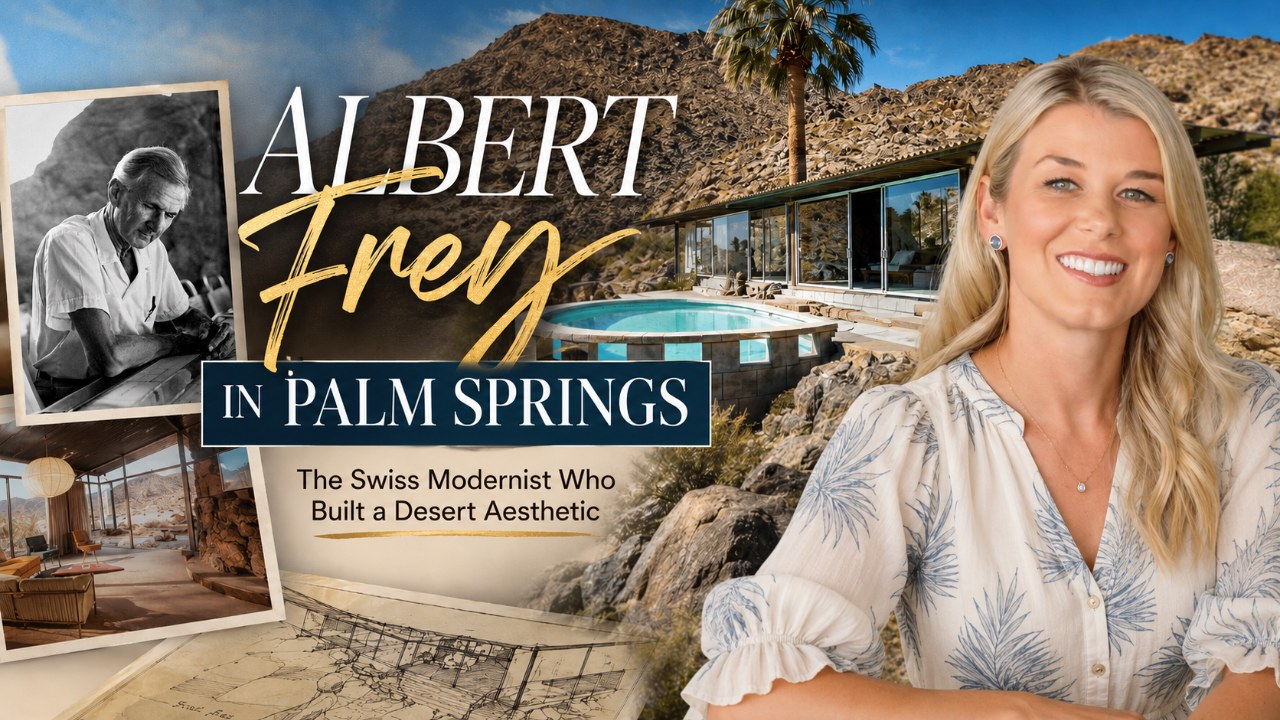
Albert Frey in Palm Springs: The Swiss Modernist Who Built a Desert Aesthetic — And the Homes Still Standing
Who was Albert Frey, and what Albert Frey homes in Palm Springs can you still visit or own today?
Albert Frey was a Swiss-born architect who moved to Palm Springs in 1934 and spent 64 years defining what desert modernism looks like — his residential work, civic buildings, and boulder-integrated structures remain among the most photographed and sought-after examples of mid-century architecture in California.
A boulder the size of a Buick sits inside a glass-walled bedroom perched on a scrubby hillside above Palm Springs. The architect who put it there didn't do it as a stunt. He did it because moving the boulder would have been beside the point.
That was Albert Frey's philosophy in a single image: work with the desert, not against it. And for nearly seven decades — from 1934 until his death in 1998 at age 95 — he lived it, literally. The house with the boulder was his own.
From Le Corbusier's Office to the Sonoran Desert
Albert Frey was born in Zurich in 1903 and trained under some of Europe's most rigorous modernist minds before landing in the New York office of Le Corbusier in the late 1920s. He helped draft plans for the Villa Savoye. He co-designed the Aluminaire House in 1931 — a prefabricated aluminum-and-steel structure that was the first house in the United States built entirely of industrial materials, and which still turns up in architecture textbooks today.
But New York wasn't where Frey was meant to be. In 1934, he arrived in Palm Springs for what was supposed to be a temporary project. He never left.
What kept him wasn't just the light, though the desert light is extraordinary. It was the problem the desert posed: extreme heat, glare, rock, sand, and open sky. For an architect trained to think rigorously about how buildings perform in their environment, the Coachella Valley was an endlessly fascinating laboratory. While peers like Richard Neutra and Rudolf Schindler worked primarily in Los Angeles, Frey planted his flag here and dug in.
The Buildings That Define a City
By the 1950s, Frey's fingerprints were on Palm Springs in ways residents walk past every day without realizing it. Palm Springs City Hall, completed between 1952 and 1957, is his — a low-slung civic composition with a brise-soleil canopy that filters the desert sun with the same logic you'd find in a Corbu sketch from thirty years earlier. It's still in use. Drive down Tahquitz Canyon Way and you'll see it.
The Palm Springs Aerial Tramway's Valley Station, completed in 1963, is another Frey landmark — a structure that had to function at the base of the San Jacinto Mountains while looking like it belonged there. It does. That same year, Frey completed the building that most clearly captures his worldview: Frey House II, perched on Palisades Drive in the San Jacinto foothills.
Frey House II is small — under 800 square feet — but it is one of the most studied residential buildings in American modernist history. Glass walls frame unobstructed views across the Coachella Valley. A swimming pool glows at the edge of the hillside. And at the center of the sleeping area, an enormous boulder that was simply too beautiful and too present to remove sits right where it's always been. Frey lived there until he died. The house is now owned by the Palm Springs Art Museum and is open for tours — a rare chance to stand inside a piece of architectural history that was also someone's actual home.
His earlier work includes the Cine Palm Springs theater (1936), one of the first projects he completed after arriving, and a long run of residential commissions that established the vocabulary still visible in Palm Springs neighborhoods today: flat or low-pitched roofs, deep overhangs, clerestory windows, corrugated metal, and a consistent refusal to pretend the desert heat doesn't exist.
Why Albert Frey Homes Still Matter in Palm Springs Real Estate
Here's what makes Frey different from other mid-century architects whose work shows up in California: he was of Palm Springs in a way most weren't. He didn't commute. He didn't take commissions in other cities and occasionally work here. He lived on the hillside, walked the streets, felt the heat, and built accordingly for over six decades.
That specificity matters when you're looking at homes in Palm Springs today. The architectural language Frey developed — the relationship between indoor and outdoor space, the integration of natural rock formations, the use of industrial materials as something beautiful rather than utilitarian — became the DNA of what we now call the Palm Springs aesthetic. It's what drives design-conscious buyers to this market from Los Angeles, New York, and beyond.
Documented Frey residential projects, where verified, carry genuine architectural provenance. The Palm Springs Preservation Foundation and the Palm Springs Art Museum are the authoritative resources for identifying verified Frey structures. If you're purchasing in Palm Springs and architectural history matters to you, knowing which buildings carry that documented lineage is worth the research before you write an offer.
What This Means For You
• Palm Springs modernist homes have documented provenance. Verified Frey commissions — or homes built in his circle during the 1940s–1960s — carry architectural significance that can affect both value and renovation restrictions. Research the history before you buy.
• Historic designation can cut both ways. A property on the Palm Springs Historic Site Register may qualify for Mills Act property tax benefits — potentially significant savings — but will also carry design review requirements for alterations. Know what you're getting into.
• Frey House II is open for tours. The Palm Springs Art Museum offers access to the house. If you're considering buying in this city, walking through it is the best orientation to what the desert modernist tradition actually feels like from the inside.
• The aesthetic is the market driver. Buyers come to Palm Springs specifically for this architecture. Understanding its origins helps you evaluate what's authentic, what's inspired, and what's just marketing copy.
Whether you're buying your first home in Palm Springs or looking for a second property with genuine architectural character, this history isn't just interesting — it's context for every decision you'll make about what's worth the price.
Ready to make your move in the Coachella Valley? Reach out to Shana Gates at Craft & Bauer. Contact Shana →
Frequently Asked Questions
Where is Frey House II located, and can the public visit it?
Frey House II is located on Palisades Drive in the hills above Palm Springs, California. It is now owned by the Palm Springs Art Museum, which offers periodic public tours — check the museum's website for current tour schedules and ticketing information.
Did Albert Frey design homes that private buyers can purchase today?
Yes. While Frey House II is museum-owned, Frey completed numerous private residential commissions in and around Palm Springs between the 1930s and 1980s. Some of those homes have changed hands on the open market. Buyers interested in documented Frey residential work should consult the Palm Springs Preservation Foundation for verified project lists before beginning their search.
What is the Mills Act, and does it apply to historic homes in Palm Springs?
The Mills Act is a California property tax incentive program that allows owners of qualifying historic properties to receive significantly reduced property tax assessments in exchange for a commitment to maintain and preserve the structure. Palm Springs has an active Mills Act program, and homes on the city's Historic Site Register may be eligible — making ownership of a documented mid-century modern home more financially accessible than many buyers expect.