
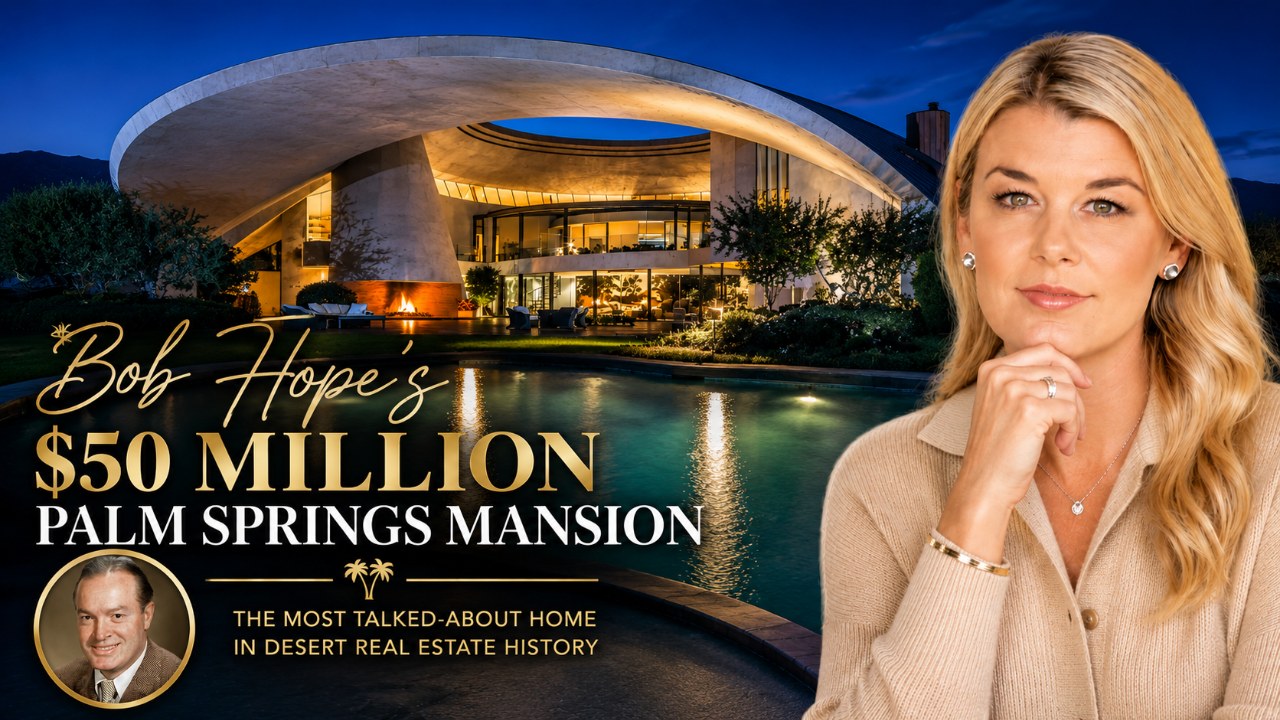
Bob Hope's $50 Million Palm Springs Mansion — The Most Talked-About Home in Desert Real Estate History
What is the story behind Bob Hope's famous Palm Springs estate designed by John Lautner?
Bob Hope's Palm Springs estate at 1 Southridge Drive is a 23,000-square-foot mid-century modern masterpiece designed by architect John Lautner, completed in 1979. After Hope's death in 2003, it was listed as high as $50 million and spent years generating international headlines before finally selling in 2016 for approximately $13 million.
The House That Stopped Traffic — and Started Conversations
It's 1973. Bob Hope — comedian, entertainer, and USO legend who had performed for troops since 1941 — has already become one of the most recognized faces in America. He's a Palm Springs fixture. And he's just hired one of the most daring architects in the country to build him something the world has never seen.
John Lautner, the architect Hope commissioned, was not the type to build a nice house with a nice view. Lautner was a Frank Lloyd Wright protégé who believed architecture should feel like it emerged from the earth itself. When he got to Palm Springs and surveyed the 2.5-acre perch on Southridge Drive overlooking the entire Coachella Valley, he didn't sketch a sprawling ranch or a sleek glass box. He drew something that looked like a volcano. Or a UFO, depending on your angle.
Construction began in 1973 and took six years. The finished structure — all 23,000 square feet of it — was completed in 1979 and instantly earned nicknames: the "volcano house," the "UFO house," and simply "that thing on the hill." The signature roofline, a massive curved form evoking a volcanic crater, is visible from much of the valley floor. It became one of the most photographed private residences in California before anyone outside Hope's inner circle ever set foot inside.
Bob Hope, Presidents, and a Palm Springs Playground
For decades, 1 Southridge Drive was less a house and more a gathering place for people who ran the world. Hope used the estate as his primary California residence, and the guest list over the years read like a who's-who of 20th-century power: sitting presidents, world leaders, A-list entertainers. The property wasn't just a home — it was a stage, a backdrop, a statement.
That's part of what made the Bob Hope Palm Springs estate and John Lautner's house design so enduring in the cultural memory. The architecture was inseparable from the man. Lautner designed spaces that commanded the landscape — floor-to-ceiling views of the valley, the mountains, the sky — and Hope filled those spaces with history for nearly thirty years.
When Hope died in July 2003 at the age of 100, the estate passed to his wife, Dolores, and eventually entered the real estate market. That's when things got complicated.
The $50 Million Listing That Became a Real Estate Legend
In 2013, the Hope estate hit the market at $50 million. It was a number that launched a thousand headlines. Architecture critics, real estate writers, and celebrity-home enthusiasts from every corner of the internet turned their attention to 1 Southridge Drive. The listing images circulated endlessly — that impossible roofline, those valley views, the scale of a building that didn't quite look real.
The problem, as any experienced Coachella Valley agent will tell you, is that extraordinary properties require extraordinary buyers. The pool of people who can spend $50 million on a second home in the desert is small to begin with. The pool of those buyers who also want 23,000 square feet of highly specific mid-century modern architecture with no obvious path to renovation is smaller still.
The price dropped. $50 million became $25 million. Then $17.5 million. The home sat. It became a recurring story not just about a house, but about the challenge of pricing legacy — about what a name, a history, and a Lautner roofline are actually worth on the open market.
In 2016, the estate finally sold to a developer for approximately $13 million — about a quarter of its original ask. The transaction closed a chapter, but the story never really ended. The Bob Hope Palm Springs estate designed by John Lautner remains one of the most discussed properties in desert real estate history, and a designated historic property that cannot simply be torn down and replaced.
Why It Still Matters Today
The Hope estate isn't just trivia. It's a lens through which to understand the Palm Springs real estate market — what drives it, what challenges it, and why mid-century modern architecture is so central to this valley's identity.
Lautner's work, like that of Richard Neutra, Albert Frey, and Donald Wexler, is the reason buyers travel from across the country to tour Palm Springs neighborhoods. Mid-century modern homes here aren't just old houses — they're designated cultural assets, many protected under the city's historic preservation ordinances. That status can affect renovation permits, listing prices, and long-term investment strategy in ways that don't apply to conventional homes.
The Hope estate also illustrates something every serious buyer in this market should understand: iconic doesn't always mean liquid. A one-of-a-kind property can sit on the market for years if pricing doesn't align with the realistic buyer pool. That's not a flaw in the home — it's a reality of ultra-luxury, highly specialized real estate.
What This Means For You
• Historic designation matters. If you're considering a mid-century modern home in Palm Springs, check its historic status early. It can affect what you can and can't change — and it can add or subtract value depending on your plans.
• Iconic architecture commands a premium — to a point. Lautner, Neutra, Frey, and Wexler homes trade at significant premiums, but the market for them is narrower. Know your exit strategy.
• Palm Springs is serious about preservation. The city's historic preservation ordinances are among the strongest in California. That's part of what protects property values in architecturally significant neighborhoods — and part of what attracts the buyers who care most about this market.
• Legacy listings take time. The Hope estate's journey from $50M to $13M over three years is an extreme example, but the lesson applies broadly: realistic pricing beats aspirational pricing, even on the most famous street in the desert.
The Bob Hope Palm Springs estate and John Lautner's volcanic masterpiece are a reminder that real estate here isn't just about square footage and comps. It's about history, architecture, and a landscape that has been attracting extraordinary people — and inspiring extraordinary buildings — for over a century. If you want to understand why Palm Springs captures the imagination the way it does, start by looking up at that roofline on Southridge Drive.
Ready to make your move in the Coachella Valley? Reach out to Shana Gates at Craft & Bauer. Contact Shana →
Frequently Asked Questions
Where is the Bob Hope Palm Springs estate located?
The Bob Hope estate is located at 1 Southridge Drive in Palm Springs, California, on a 2.5-acre elevated lot overlooking the Coachella Valley. The property is clearly visible from much of the valley floor due to its distinctive volcanic crater-shaped roofline designed by architect John Lautner.
How much did the Bob Hope Palm Springs house sell for?
After being listed at $50 million in 2013 and later reduced to $25 million and then $17.5 million, the estate ultimately sold in 2016 for approximately $13 million to a developer. The lengthy price journey became one of the most-followed real estate stories in the country during that period.
Is the Bob Hope estate a historic landmark?
Yes, the Bob Hope estate is a designated historic property in Palm Springs, which places restrictions on significant alterations to its exterior and key architectural features. Palm Springs has robust historic preservation ordinances that apply to many mid-century modern properties throughout the city, making historic status an important factor for any buyer or investor to research before purchasing.