
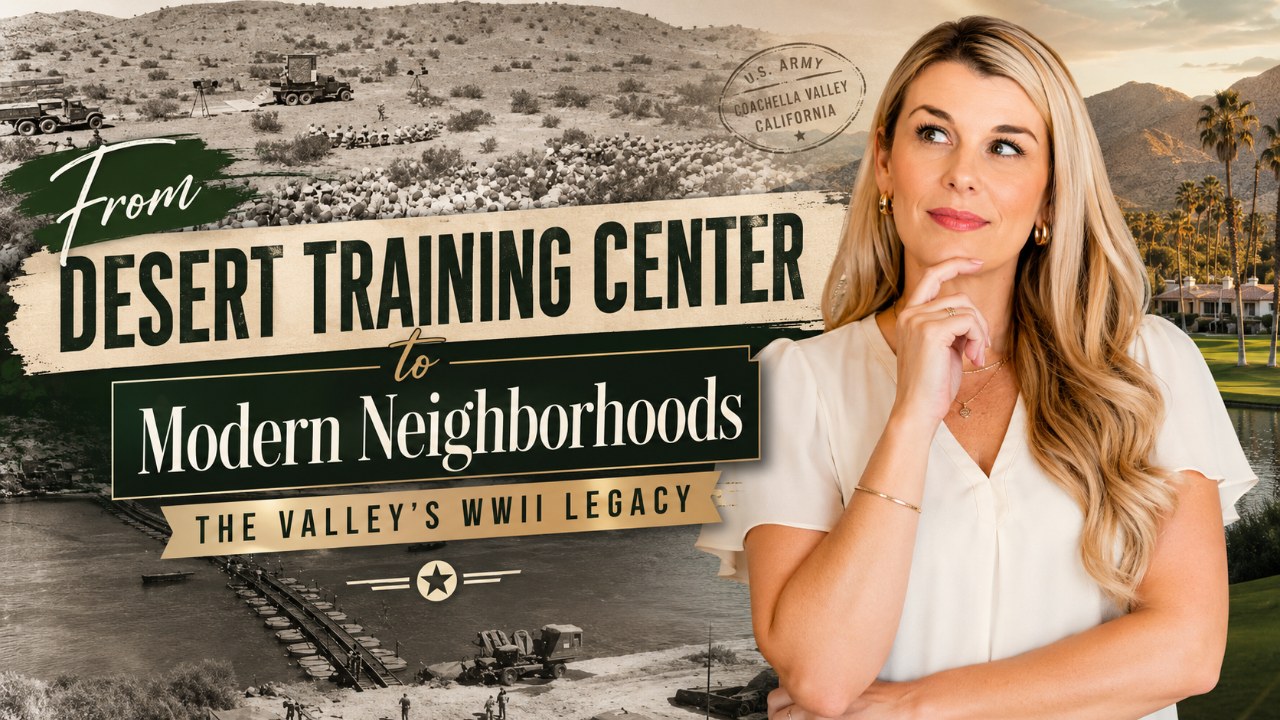
From Desert Training Center to Modern Neighborhoods: The Valley's WWII Military History and Today's Housing
How did World War II military training shape the Coachella Valley's roads, neighborhoods, and postwar housing boom?
General Patton's Desert Training Center transformed millions of acres of Coachella Valley desert into the largest military training ground in American history — and when the war ended, the GIs who trained here came back as homebuyers, igniting a building boom that still defines the valley's neighborhoods today.
"The Biggest Army Camp in the World" Was Right Here
April 1942. General George S. Patton Jr. stood on a rocky bluff near Chiriaco Summit, looked out over an ocean of sand, creosote, and shimmering heat, and declared it perfect. Not for a resort. Not for a golf course. For war.
Within weeks, the Desert Training Center — later redesignated the California-Arizona Maneuver Area — was operational across 18,000 square miles of the Mojave and Sonoran deserts, stretching from the Coachella Valley deep into Arizona. Headquarters was Camp Young, set just off what is now Interstate 10 near Chiriaco Summit. At its peak, more than one million American soldiers trained across this terrain, rehearsing armored warfare under conditions Patton believed mirrored the North African desert where they'd soon fight Rommel.
Patton's logic was blunt and correct: if you could maneuver a Sherman tank column through 115-degree heat with no paved roads and sand that swallowed vehicles whole, you could fight anywhere. The valley's flat, open terrain between Palm Springs and Indio wasn't an obstacle — it was the point. Soldiers practiced communications across the open basin, dug foxholes in caliche hardpan, and ran convoy routes along corridors that would later become some of the valley's most-traveled roads.
Camp Young today is home to the General Patton Memorial Museum, a genuinely fascinating stop at Chiriaco Summit. The original headquarters site is marked, and the museum holds tanks, maps, and personal artifacts from the training era. If you've driven past it on I-10 a hundred times and never stopped, you've been missing something.
Airfields, Infrastructure, and the Desert Grid That Shaped Today's Streets
The military doesn't just train troops — it builds. And what the Army built across the Coachella Valley between 1942 and 1944 left marks on the landscape that are still legible today.
Two airfields were critical to the Desert Training Center's operations: the Thermal Airport (now Jacqueline Cochran Regional Airport near Coachella and Indio) and the Palm Springs Army Air Field, which occupied the footprint of what eventually became Palm Springs International Airport. The Palm Springs airfield hosted training for pursuit pilots and served as a logistics hub for the vast training area. When the war ended and the military withdrew, both facilities transitioned to civilian use — and those transitions were pivotal. Palm Springs International today handles direct flights to dozens of cities and is central to the valley's economy. Jacqueline Cochran Regional Airport remains an active general aviation field supporting agriculture, cargo, and private aviation in the eastern valley.
Beyond the airfields, the military grid of roads and supply corridors left its imprint on the valley's street system. The army needed to move equipment fast across open desert, and they did it by laying down direct, logical routes — routes that civilian planners later paved, named, and built neighborhoods around. The wide, straight arterials that make Palm Desert, Cathedral City, and Rancho Mirage so easy to navigate aren't an accident of geography. They reflect a wartime logic of movement and supply that got baked into the postwar planning grid.
Communication infrastructure followed the same pattern. The military's need for reliable links across the valley basin accelerated utility corridors that civilian developers later tapped for water, power, and telephone lines — the invisible skeleton on which 1950s tract development was laid.
The GIs Came Back — and They Bought Houses
When the war ended in 1945, hundreds of thousands of soldiers who had trained in the Coachella Valley's desert returned home — many of them to California. A significant number came back to the valley itself. They'd seen the sunshine, felt the dry heat soothe aching joints, and remembered the wide-open space. With GI Bill financing in hand and a booming postwar economy behind them, they came back as buyers.
The timing collided perfectly with two other forces: the expansion of Highway 111 as a true regional artery, and the arrival of developers who understood that the desert was no longer exotic — it was aspirational. The Alexander Construction Company, founded by George Alexander and later run by his son Bob, became the defining force of the valley's postwar residential identity. Between the mid-1950s and the early 1960s, the Alexanders built thousands of homes across Palm Springs and the mid-valley — flat-roofed, glass-walled, carport-fronted modernist tract homes designed by architects including William Krisel. The price point was accessible. The design was revolutionary.
Those Alexander homes — now called "Alexanders" by collectors and preservationists — are among the most coveted properties in Palm Springs today. What was built as affordable postwar housing for working- and middle-income buyers now trades at serious premiums, often $700,000 to well over $1 million for a restored original. The postwar military-to-civilian pipeline didn't just fill the valley with residents — it defined its architectural character for generations.
East of Palm Springs, the same postwar energy flowed into what would become Palm Desert (incorporated 1973), La Quinta, and eventually the golf and resort communities that define the mid-valley today. La Quinta's grid of golf communities, Indian Wells's resort corridor, and Rancho Mirage's gated enclaves all trace their DNA, in part, to the postwar migration of buyers who knew and trusted this desert.
What This Means for You
• The valley's infrastructure has deep roots. Roads, airports, and utility corridors you rely on today were shaped by wartime military planning — which is part of why the valley's grid is so logically laid out compared to organically grown cities.
• Postwar architecture is a real asset class. If you're drawn to mid-century modern homes — the flat roofs, clerestory windows, and open plans — you're looking at a direct legacy of the postwar GI buyer wave. These homes hold value and carry a story.
• History connects to value in specific neighborhoods. Understanding why certain streets, lot configurations, and neighborhood layouts exist can help you ask smarter questions when you're buying. A home on a wide arterial that dates to military-era planning has different noise and traffic characteristics than one tucked into a postwar cul-de-sac.
• The eastern valley's airport infrastructure matters. Jacqueline Cochran Regional Airport and Palm Springs International both trace to wartime airfields. For buyers considering locations near either facility, it's worth understanding flight path patterns and long-term development plans around both.
The Coachella Valley's Coachella Valley WWII military history isn't just trivia. It's the origin story of the roads you drive, the airport you fly out of, and some of the most architecturally significant homes in Southern California. The desert that Patton used to prepare soldiers for combat became, almost immediately after the war, a place those same soldiers chose to call home.
If you're buying, selling, or just trying to understand this valley more deeply — that history is part of what you're investing in. I love talking about it. Reach out anytime.
Ready to make your move in the Coachella Valley? Reach out to Shana Gates at Craft & Bauer. Contact Shana →
Frequently Asked Questions
Where was General Patton's Desert Training Center located in the Coachella Valley?
Patton's headquarters, Camp Young, was located near Chiriaco Summit along what is now Interstate 10, east of the Coachella Valley proper. The training area itself spread across millions of acres including the open desert basin between Palm Springs and Indio. The General Patton Memorial Museum at Chiriaco Summit marks the original site and is open to the public.
How did WWII military training affect Palm Springs' airport and roads?
The Palm Springs Army Air Field, active during WWII, occupied the same site as today's Palm Springs International Airport — the military's investment in runways and infrastructure directly enabled the civilian airport that serves the valley now. Road corridors used for military convoy and supply movement also influenced the straight, wide arterial grid that characterizes cities like Palm Desert, Cathedral City, and Rancho Mirage today.
What are Alexander homes and why are they connected to WWII history?
Alexander homes are mid-century modern tract houses built primarily by the Alexander Construction Company in Palm Springs during the 1950s and early 1960s, many designed by architect William Krisel. The postwar building boom that created them was fueled in large part by returning GI Bill-eligible veterans — many of whom had trained in the California desert during WWII and chose to return as residents. Today, well-preserved Alexanders are among the most sought-after homes in Palm Springs, frequently selling between $700,000 and well over $1 million.