
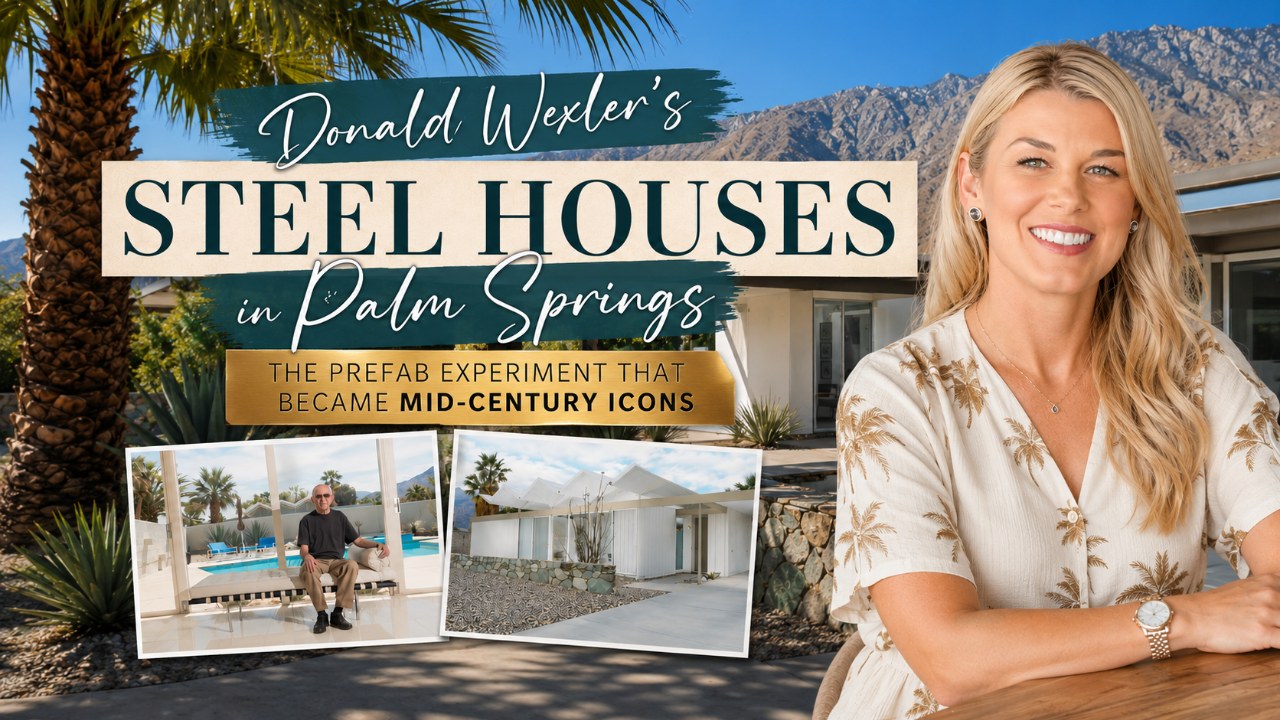
Donald Wexler's Steel Houses in Palm Springs: The Prefab Experiment That Became Mid-Century Icons
What are Donald Wexler's steel houses in Palm Springs, and why are they so valuable today?
Donald Wexler designed seven prefabricated steel homes in Palm Springs' Desert Highlands neighborhood in 1962, in partnership with US Steel. The program was cancelled after those seven were built — and those houses are now among the most architecturally significant and financially valuable mid-century homes in the entire Coachella Valley.
It's 1962. US Steel has a problem: the American housing market is booming, construction labor is expensive, and someone needs to prove that factory-built steel homes can compete with wood-frame tract housing. Their solution is to find an architect bold enough to try it in the desert — and they find Donald Wexler.
Wexler, a Frank Lloyd Wright–trained architect who had relocated to Palm Springs in 1953, was already well on his way to reshaping the city's built landscape. He'd been designing homes that worked with the desert rather than against it — deep overhangs, walls of glass oriented toward mountain views, post-and-beam frames that let the structure breathe. When US Steel came calling, Wexler saw an opportunity to take those principles and industrialize them. Forty homes, all prefabricated, all steel. A new template for desert living.
He got seven.
The Experiment: Steel in the Desert Sun
The Desert Highlands tract, tucked into the north end of Palm Springs, was the proving ground. Wexler designed the steel houses with a clear logic: prefabricated panels would be assembled on-site, dramatically cutting labor costs and construction time. The post-and-beam steel frames were elegant — far lighter-looking than the chunky wood construction common in tract housing — and they allowed for the floor-to-ceiling glass walls that defined Wexler's aesthetic. Flat roofs. Generous overhangs to block the brutal summer sun. Carports rather than enclosed garages, keeping the street-facing facade open and horizontal.
On paper, it all worked. In practice, the desert had opinions. Steel conducts heat with ruthless efficiency, and keeping the interiors cool during Palm Springs summers — where temperatures regularly exceed 110°F — proved far more challenging than the project's promoters had anticipated. Insulation costs climbed. The economics that were supposed to make steel prefab competitive with wood framing began to erode. US Steel reviewed the numbers after the seventh home was completed and made a quiet, corporate decision: the program was over.
Wexler moved on. He went on to design the Palm Springs International Airport terminal, the Sunmor tract neighborhood, and much of Desert Hospital. His steel houses sat in Desert Highlands, occupied and lived-in, not yet famous — just seven quietly unusual homes on tree-lined streets.
From Abandoned Experiment to Architectural Icons
The reassessment took decades. As mid-century modernism shifted from "old" to "collectible" — a cultural turn that accelerated through the 1990s and exploded with Modernism Week, which now draws tens of thousands of visitors to Palm Springs every February — Wexler's steel houses emerged as something genuinely rare: a documented experiment that almost didn't happen, survived by only seven examples, in a city that had become ground zero for MCM preservation.
Today, the Donald Wexler steel houses in Palm Springs routinely command prices three to five times what a comparable Alexander Construction Company tract home sells for. That's not just aesthetic premiums — it's scarcity economics applied to architecture. There are exactly seven. There will never be more. Collectors and architecture enthusiasts understand that equation immediately.
Wexler himself lived to see the recognition. He passed away in 2015 at age 88, having watched the city he helped design become a global destination for the architecture he once built simply because it seemed like the right thing to do.
Why It Still Matters Today
The steel houses aren't just a historical footnote — they're an active part of the Palm Springs real estate market, and understanding them matters if you're serious about buying in this city.
The broader lesson from Wexler's steel houses is one that applies to every architecturally significant home in the Coachella Valley: provenance is permanent, and scarcity compounds over time. A home that was considered a quirky experiment in 1962 is a museum-quality asset in 2025. That's not an accident — it's the result of a city that has consistently chosen to celebrate its architectural heritage rather than pave over it.
If you're drawn to Palm Springs specifically for its mid-century architecture, understanding the hierarchy of that market — from Alexander tracts to Wexler steels to the custom estates of the Movie Colony — will make you a sharper buyer. I've written more about navigating the Palm Springs mid-century home market if you want to go deeper.
What This Means For You
• Scarcity is real. With only seven steel houses ever built, there are no comps in the traditional sense. Pricing reflects rarity and cultural cachet as much as square footage or condition.
• Architectural provenance commands a premium. Documented Wexler, Palmer & Krisel, or Albert Frey designs in Palm Springs consistently outperform non-attributed mid-century homes — often significantly.
• Condition and authenticity matter enormously. Buyers in this niche pay a sharp premium for homes with original details intact. Unsympathetic renovations can materially reduce value.
• Know what you're buying into. Steel construction has specific maintenance and climate-control considerations unique to this building type. A pre-purchase inspection by someone familiar with mid-century steel construction is essential.
The seven steel houses on those quiet Desert Highlands streets are a reminder that Palm Springs has always attracted people willing to try something that shouldn't work in the desert — and occasionally produce something unforgettable. That spirit is still here, still drawing buyers, still making this one of the most interesting real estate markets in California.
Ready to make your move in the Coachella Valley? Reach out to Shana Gates at Craft & Bauer. Contact Shana →
Frequently Asked Questions
Where are Donald Wexler's steel houses located in Palm Springs?
The seven steel houses Wexler designed in partnership with US Steel are located in the Desert Highlands neighborhood in north Palm Springs, built in 1962. The neighborhood is accessible and recognizable to anyone familiar with the city's mid-century residential tracts, though the steel houses stand apart from their neighbors in both construction method and architectural character.
How much do Donald Wexler's steel houses sell for?
Because only seven exist, sales are infrequent and pricing varies significantly based on condition, renovation history, and market timing. As a general benchmark, these homes have historically sold at three to five times the price of comparable Alexander tract homes in Palm Springs — placing them well into the upper tier of the Palm Springs mid-century market when they do come available.
What makes Wexler's steel houses different from other Palm Springs mid-century homes?
Unlike the wood-frame post-and-beam construction used by most Palm Springs mid-century builders, Wexler's steel houses use prefabricated steel panels and structural steel frames — the only residential application of this system ever completed in Palm Springs. That unique construction method, combined with their documented history as a failed US Steel mass-production experiment, gives them a provenance and scarcity that sets them apart from even other notable mid-century designs in the city.