
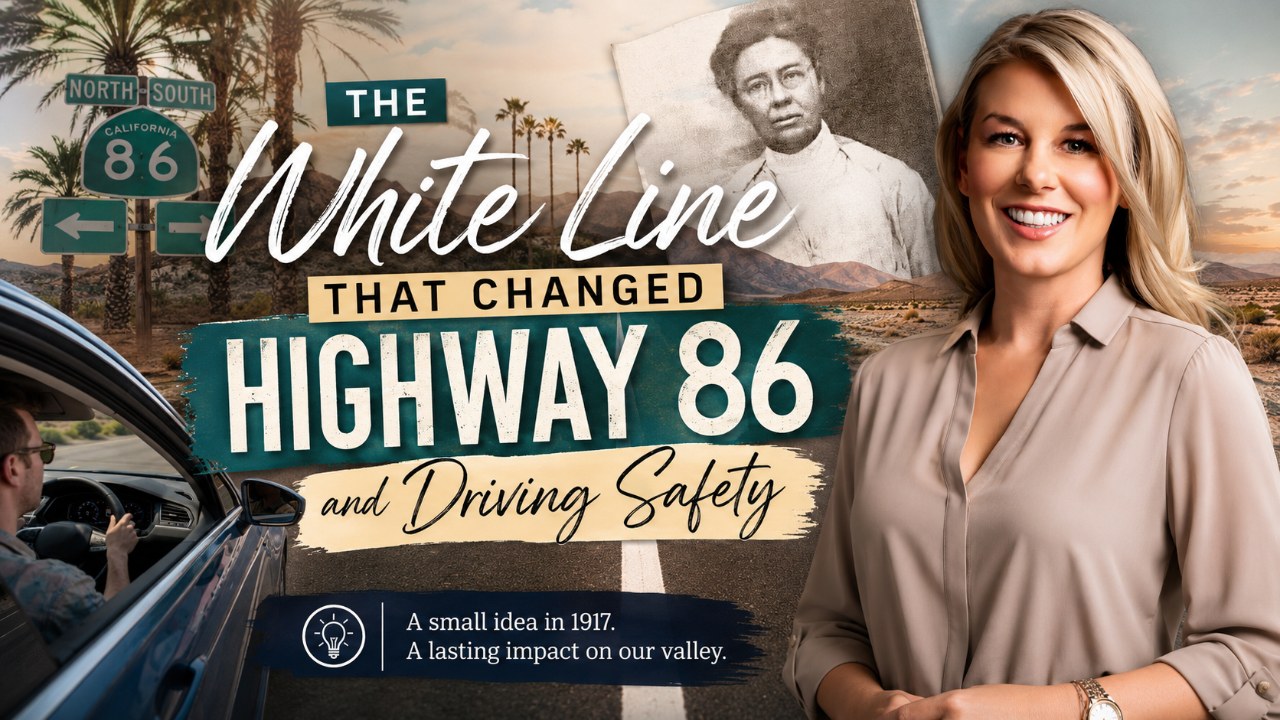
How a Simple White Line on Highway 86 Changed Driving — and Safety — in the Coachella Valley
How did the painted centerline on the road get its start — and what does it have to do with Coachella Valley real estate?
In 1917, a nurse named June McCarroll painted a white stripe down the center of a desert road near Indio and inadvertently invented one of the most universal safety features in modern driving. That same stretch of pavement — and the corridors that grew around it — directly shapes where people live, how long their commutes take, and what homes are worth across the valley today.
The Woman Who Drew the Line: June McCarroll and the Highway 86 White Line History
November 1917. June McCarroll is driving her Model T along a rough dirt road south of Indio when a truck forces her off the road entirely. She isn't hurt, but she's furious — and she starts thinking. McCarroll, a physician and nurse who had settled in the eastern Coachella Valley, proposed a solution so simple it seems obvious in hindsight: paint a white line down the center of the road to divide opposing traffic.
She didn't wait for a committee. She grabbed a bucket of white paint and did it herself on a stretch of what would later become part of the Highway 86 corridor. Local officials largely ignored her at first. She spent years lobbying, writing letters, attending meetings — and in 1924, California became one of the first states to adopt the painted centerline as a statewide roadway standard. By the 1950s, it had become a universal feature of roads across the United States and, eventually, the world.
A commemorative marker honoring McCarroll now stands near Indio, and in 2002 the California Legislature passed a resolution recognizing her contribution. The next time you're driving down Highway 86 through the east valley and you glance at that white line keeping two lanes of traffic safely apart — that's her legacy. It's the kind of origin story you don't expect to find in the desert, but that's one of the things I love most about this valley: the history here runs deep and it shows up in the most ordinary places.
From One White Line to Three Major Corridors: How Highways Shape the Valley
That painted stripe on a dusty Indio road was an early signal that the Coachella Valley was going to need real infrastructure — because people were going to keep coming. And they did. Today, three main highway corridors define how the valley functions, how long your commute takes, and, frankly, how much your home costs.
Highway 111 is the resort spine. Running through Palm Springs, Cathedral City, Rancho Mirage, Palm Desert, and Indian Wells, it connects the commercial and cultural heart of the west valley. Traffic on 111 during peak snowbird season — roughly November through April — can slow to a crawl near the El Paseo shopping district or the intersection at Country Club Drive. For buyers considering a home anywhere along this corridor, that's a real lifestyle variable worth factoring in.
Interstate 10 is the valley's connection to the outside world. The 10 links Desert Hot Springs and the west valley to Los Angeles (roughly 110 miles west) and Phoenix to the east. Commuters who work in LA and weekend in the valley — or who've relocated here full-time but maintain ties to Southern California — live and die by I-10. The interchange near La Quinta and Coachella has improved access to the east valley significantly, making cities like Indio and Coachella increasingly attractive to buyers who once defaulted to Palm Desert or Rancho Mirage.
Highway 86 is the corridor that often gets overlooked — which is exactly why it matters for buyers willing to do a little homework. Running along the western edge of the Salton Sea from the I-10 interchange south through Coachella and beyond, Highway 86 serves the agricultural east valley and provides a direct southern route that bypasses much of the Highway 111 congestion. It's not a glamour road, but for certain destinations in the southern and eastern valley, it's the faster path.
West Valley vs. East Valley: What the Corridors Mean for Commutes and Home Prices
Here's where the highway trivia becomes practical real estate math. The Coachella Valley is about 45 miles long, and the difference in home prices from one end to the other is dramatic — but so is the difference in commute times, access, and lifestyle.
In the west valley — Palm Springs, Cathedral City, Rancho Mirage, Indian Wells, and Palm Desert — you're close to Highway 111 amenities, major medical facilities, the BNP Paribas Open at Indian Wells Tennis Garden, and the I-10 on-ramps that get you to LA. Median home prices in this stretch run from roughly $400,000 in Cathedral City to well above $1 million in Indian Wells. You're paying for proximity and polish.
In the east valley — Indio, Coachella, and the communities along the Highway 86 expressway — home prices are meaningfully lower. Indio's market runs from approximately $300,000 to $800,000; Coachella sits in a similar range. These cities host the Coachella Valley Music and Arts Festival and Stagecoach every April, which creates strong short-term rental demand for investors willing to navigate the permitting landscape. The trade-off is a longer drive to west valley amenities — and a commute to LA that adds roughly 15–20 minutes compared to driving from Palm Springs.
Cathedral City and Desert Hot Springs serve as interesting middle cases. Cathedral City sits between Palm Springs and Rancho Mirage on Highway 111, offering some of the most affordable entry-level pricing in the mid-valley. Desert Hot Springs, perched north of I-10 with its own hot springs and a growing roster of wellness-oriented developments, has become a genuinely interesting buy for buyers priced out of the more established west valley cities.
If you want a deeper look at how individual city corridors compare for buyers, this city-by-city breakdown of the Coachella Valley is worth your time.
What This Means For You
• Commute time is a real differentiator. A home in Coachella can save you $150,000–$300,000 versus a comparable property in Palm Desert — but budget an extra 20–30 minutes for any west valley errand or appointment. Know your tolerance before you fall in love with a price point.
• The Highway 86 corridor is undervalued and underexplored. East valley buyers who understand the road network can find real value in Indio and Coachella, particularly for investment properties tied to festival-season short-term rental income.
• I-10 access is the single biggest factor for LA commuters. If you're buying a home and maintaining any regular connection to the Los Angeles metro, your proximity to an I-10 interchange will shape your daily life more than almost any other feature.
• West valley highways come with seasonal friction. Highway 111 congestion between January and April is genuine. If you're a full-time resident rather than a seasonal visitor, factor peak-season traffic into your decision about which city to prioritize.
June McCarroll painted one white line on a desert road more than a century ago, and the ripple effects are still visible in the commutes, the corridors, and the communities that grew up around them. The Coachella Valley's highway network isn't just infrastructure — it's the skeleton the whole market is built on. Understanding it makes you a smarter buyer, a better-informed seller, and a more confident investor.
Ready to make your move in the Coachella Valley? Reach out to Shana Gates at Craft & Bauer. Contact Shana →
Frequently Asked Questions
Who invented the painted centerline on the road?
June McCarroll, a nurse and physician living near Indio, California, is widely credited with pioneering the painted road centerline. After being forced off the road by a truck in 1917, she painted a white stripe down the center of a local desert road — part of what would become the Highway 86 corridor — and spent years advocating for it as a statewide safety standard. California formally adopted the centerline in 1924, and a state legislative resolution honored her contribution in 2002.
How does Highway 86 compare to Highway 111 for getting around the Coachella Valley?
Highway 111 is the primary commercial and residential corridor through the west valley, connecting Palm Springs to Indian Wells and Palm Desert. Highway 86 runs along the eastern and southern end of the valley, serving Indio, Coachella, and the agricultural communities near the Salton Sea. For buyers in the east valley, Highway 86 provides an important alternate route that avoids the heavier congestion on 111 during peak snowbird season.
Which Coachella Valley cities have the best highway access for commuters traveling to Los Angeles?
Palm Springs, Cathedral City, and Rancho Mirage offer the quickest access to I-10 westbound, putting the LA metro approximately 1.5 to 2 hours away under normal traffic conditions. La Quinta and Indio are roughly 15–20 minutes farther from the key I-10 westbound interchanges, which is a meaningful difference for anyone making that drive regularly. Desert Hot Springs also sits near I-10 to the north, making it a surprisingly accessible option for LA-connected buyers seeking lower price points.