
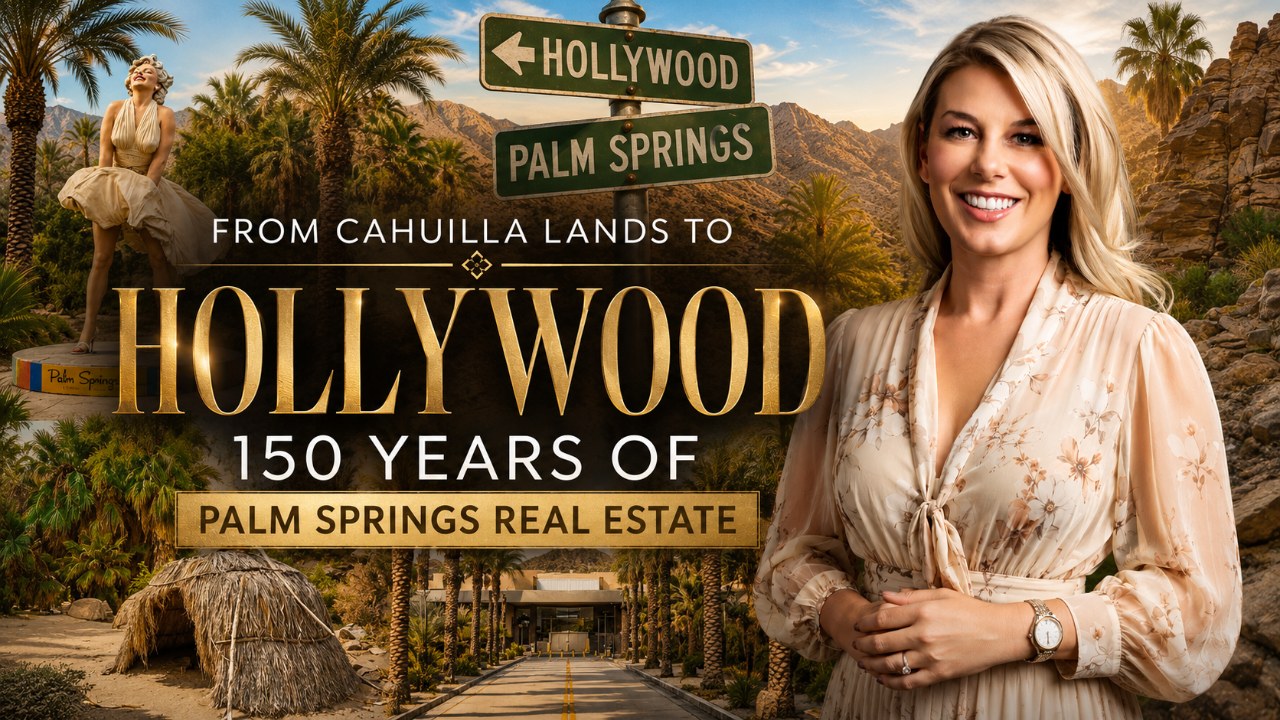
The History of Palm Springs Real Estate: From Cahuilla Homeland to Design Capital
What is the history of Palm Springs real estate, and how did it become one of California's most iconic property markets?
The history of Palm Springs real estate spans more than 150 years — from a federally imposed land-grant checkerboard that still shapes property ownership today, to a Hollywood golden age that turned the desert into a glamour destination, to a mid-century architecture boom that made the city a global design landmark.
It is January 1, 1900, and Palm Springs is not yet a city. There are no movie stars. No infinity pools. No open houses with chilled rosé. There is a small Southern Pacific Railroad depot, a handful of wooden structures, and a vast grid of alternating land sections — half belonging to the federal government, half belonging to the Agua Caliente Band of Cahuilla Indians — stretching across the valley floor beneath the San Jacinto Mountains. This strange patchwork of ownership, born from a single act of Congress in 1876, would quietly shape every real estate transaction in Palm Springs for the next century and a half. And most buyers today have no idea it even exists.
The Cahuilla Homeland and the Checkerboard
Long before real estate agents and lot surveys, the Cahuilla people lived in this valley for thousands of years, sustained by the hot mineral springs, the palm oases, and the rich ecological diversity of the desert. Their connection to the land was intimate and permanent.
That began to change in 1876, when Congress granted every other section of land along the Southern Pacific Railroad corridor to the railroad itself, in one-mile alternating squares — a checkerboard pattern. The sections not granted to the railroad were reserved for the Agua Caliente Band of Cahuilla Indians. On paper, this gave the tribe significant land holdings in what would become downtown Palm Springs. In practice, the federal government held those parcels in trust, and for decades the Agua Caliente were barred from selling, leasing, or developing their own land — a legal tangle that stunted Palm Springs development well into the mid-20th century.
This checkerboard legacy is not just a footnote. It is why, even today, many Palm Springs properties sit on land that is leased from the Agua Caliente Band rather than owned outright. If you've ever seen "land lease" on a Palm Springs listing and wondered what it means — now you know where that comes from.
The 1920s Discovery and Hollywood's Retreat
The resort era began quietly in the early 1900s, driven largely by tuberculosis patients drawn to the dry desert air under doctors' orders. But the defining chapter in the history of Palm Springs real estate opened in the 1920s, when a different kind of visitor arrived: Hollywood.
Film studios operating under strict "two-hour rule" morality clauses — requiring stars to remain within two hours of Los Angeles — discovered that Palm Springs sat just at the edge of that radius. Suddenly, actors, directors, and moguls could escape studio scrutiny while staying technically compliant. Estates began rising in the foothills. The El Mirador Hotel opened in 1928 and quickly became the social center of the desert. Names like Clark Gable, Cary Grant, and Dinah Shore weren't just visitors — they were property owners, and their presence turned Palm Springs into a brand.
This era planted the seed of Palm Springs' dual identity as both playground and prestige address — a tension that defines the market to this day.
The 1947 Architecture Boom and Its Enduring Legacy
After World War II, a generation of architects descended on Palm Springs with radical ideas about how humans should live in a desert climate. William Krisel, Albert Frey, Richard Neutra, Donald Wexler — these names are not just history. They are the reason a two-bedroom home on a quarter-acre lot in the Movie Colony or the Twin Palms neighborhood can command $1.2 million today.
The post-1947 building boom produced thousands of homes built around flat roofs, floor-to-ceiling glass, deep overhangs, and seamless indoor-outdoor living — all design responses to the desert sun. The Alexander Construction Company alone built over 2,200 homes across Palm Springs between 1955 and 1965, most of them Krisel-designed. These homes were originally marketed as affordable, modern tract housing. Today they are the subject of international architecture pilgrimages and Modernism Week, which draws tens of thousands of visitors to Palm Springs each February.
The 2000s preservation movement formalized what design enthusiasts had long known: these homes were culturally significant. Historic designation began protecting key properties, and with protection came premium pricing. A well-preserved Alexander home with a restored butterfly roof isn't just a house — it is a collectible.
Why It Still Matters Today
Understanding the history of Palm Springs real estate isn't just interesting — it's genuinely useful if you're buying, owning, or investing here.
• Land lease vs. fee simple: Many Palm Springs parcels sit on Agua Caliente tribal land. Lease terms, expiration dates, and ground rent structures vary significantly and affect financing, value, and resale. Always verify land ownership status before making an offer.
• Historic designation: A Class 1 or Class 2 historic designation can limit renovations but dramatically increase a home's cachet and value. Know what you're buying.
• The remote-work boom of the 2020s: The COVID-era shift to remote work sent a new wave of buyers into Palm Springs, compressing a market already constrained by limited land (mountains to the west, tribal trust land throughout). Prices that seemed high in 2019 became the floor by 2022. That structural land scarcity isn't going away.
• Design as a value driver: In few markets in America does architectural pedigree matter as much as it does in Palm Springs. Mid-century provenance — the architect, the builder, the era — directly influences price per square foot.
The desert has always attracted people who saw something others didn't. The Cahuilla saw sustenance and home. The Hollywood stars saw freedom. The architects of the 1950s saw a canvas. Today's buyers see a combination of all three — and the history of this market helps explain why demand here has proven so remarkably durable.
If you're thinking about buying in Palm Springs or anywhere across the Coachella Valley, I'd love to be a resource — not just for listings, but for the context that makes a smart purchase possible.
Ready to make your move in the Coachella Valley? Reach out to Shana Gates at Craft & Bauer. Contact Shana →
Frequently Asked Questions
What is a land lease in Palm Springs and how does it affect buying a home?
A land lease means you own the structure but lease the ground it sits on — in Palm Springs, often from the Agua Caliente Band of Cahuilla Indians, a legacy of the 1876 federal land-grant checkerboard. Lease terms, ground rent amounts, and expiration dates vary by parcel and can significantly impact your financing options, long-term costs, and resale value. Always review the lease terms carefully with your agent and a real estate attorney before purchasing a leased-land property.
Why are mid-century modern homes so expensive in Palm Springs?
Mid-century modern homes in Palm Springs — particularly those designed by architects like William Krisel, Richard Neutra, or Albert Frey — command premium prices because of their architectural rarity, strong preservation community, and global design recognition. Events like Modernism Week drive international buyer interest, and historic designations have further codified their cultural value. Supply is limited and largely non-reproducible, which keeps demand strong relative to inventory.
When did Palm Springs become a popular real estate market?
Palm Springs began attracting significant real estate interest in the 1920s, when Hollywood studios and celebrities discovered the desert as a convenient and glamorous escape from Los Angeles. The post-World War II building boom of the late 1940s through the 1960s dramatically expanded the housing stock, and the 2000s preservation movement — followed by the 2020s remote-work migration — cemented Palm Springs as one of California's most consistently in-demand property markets.