
October 9, 1999. About 25,000 people drove out to a polo field in Indio to watch Beck, Tool, and Rage Against the Machine perform under the desert sky. The promoters lost somewhere around $800,000. The event shut down after two days, and most people in the industry assumed it was over.
That was Coachella's first edition. It was, by nearly every financial measure, a failure.
Twenty-seven years and twenty-five staged editions later, that same polo field hosts one of the most-watched music events on Earth, draws over 125,000 people per weekend across two consecutive weekends, and generates economic activity that touches every corner of the Coachella Valley. Understanding how Coachella transformed Indio from an agricultural desert community into a global music destination is, for anyone who lives here, worth knowing cold.
The Polo Club That Proved It Was Possible
The story starts even earlier than 1999. In 1993, Pearl Jam played a concert at the Empire Polo Club after the band protested Ticketmaster's service fees and needed a venue outside the traditional touring system. The show drew a massive crowd to Indio's flat, open polo grounds and demonstrated something that wasn't obvious at the time: the desert could hold a major destination event.
Goldenvoice, the Los Angeles-based promoter behind many of Southern California's biggest concerts, filed that lesson away. By the late 1990s, they were looking for a way to build a multi-day festival outside the constraints of existing amphitheaters. The Empire Polo Club, with its acreage, its proximity to Interstate 10, and its location in a valley full of hotel inventory stretching from Palm Springs to the Salton Sea, looked like the right place.
The 1999 debut nearly killed the idea permanently. But Goldenvoice's Paul Tollett believed in the concept. Two years later, in April 2001, Coachella returned. That second edition turned a profit. The trajectory from there was not a straight line upward, but it was consistently upward.
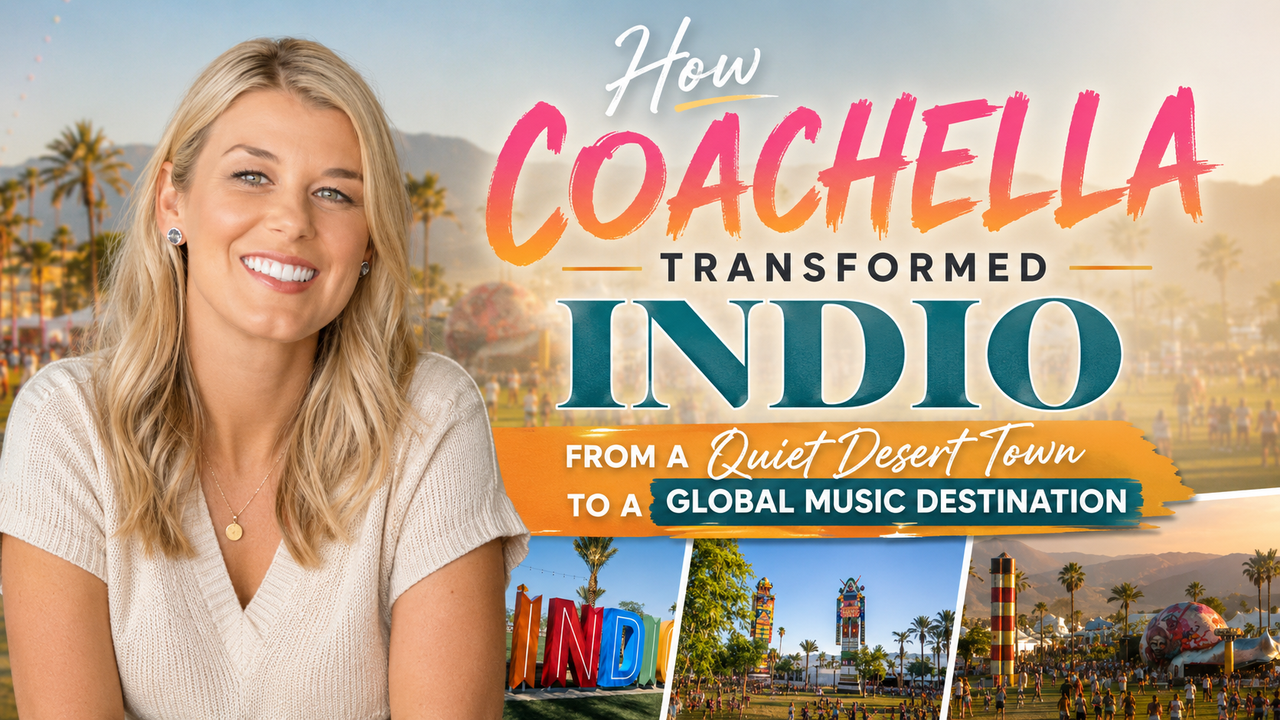
How Coachella Transformed Indio From a Quiet Desert Town Into a Global Music Destination
Indio in the 1990s was a working agricultural city. Date palms, citrus, and a stretch of old Route 99 commercial development defined its character. It sat east of the resort corridor, past the golf communities of Indian Wells and La Quinta, and most valley visitors never went that far.
Coachella changed the geography of attention. As the festival grew through the 2000s, adding larger headliners and expanding to two weekends in 2012, Indio's name started appearing in international travel coverage. Hotel occupancy across the valley during festival weeks hit numbers that no other event, not the BNP Paribas Open in Indian Wells, not the Palm Springs International Film Festival, could match.
The economic ripple moved fast. Short-term rental demand around festival weekends created a cottage industry for homeowners across the valley. Properties within 20 miles of the polo grounds began commanding nightly rates during Coachella weekends that rivaled Aspen or Miami Beach during peak season. Investors took notice. By the mid-2010s, Indio's proximity to the festival grounds was showing up as a line item in property investment calculations.
The city itself changed. New hotel development targeted the festival corridor along Monroe Street. Local restaurants and businesses built their calendars around festival traffic. Indio went from a city the valley's resort economy largely bypassed to one of its biggest economic engines, twice a year, every April.
What the 25th Edition Means for the Valley Today
2026 marked the 25th staged edition of Coachella. The festival has now operated long enough to have shaped an entire generation's understanding of what the Coachella Valley is. For many people outside California, Indio and Coachella are the same word.
That global name recognition has real consequences for residents. Property values in Indio and the broader east valley have grown alongside the festival's profile. The short-term rental market that Coachella essentially created here is now a permanent feature of the valley's housing economy. Cities including Palm Desert, Rancho Mirage, and Cathedral City all field consistent rental demand tied, at least in part, to the festival's gravitational pull.
For locals who remember Indio before Coachella, the transformation is hard to overstate. The city that was once one of the least visited spots on the valley's map is now the reason millions of people around the world know the valley exists.
That matters for everyone who owns property here, considers buying here, or simply calls this place home. Coachella is the valley's loudest ambassador, and after 25 editions, it shows no signs of going quiet.
If you want to explore more of the Coachella Valley's history and what it means for living and investing here, browse the Craft & Bauer local history blog for stories covering the full valley.
---
*Shana Gates is a Coachella Valley real estate expert with Craft & Bauer | Real Broker. She has lived and worked in the valley for years and covers the full desert, from Desert Hot Springs to the Salton Sea. If this piece sparked questions about what the valley's story means for your property decisions, she's always glad to talk.*
Frequently Asked Questions
When did the Coachella Valley Music and Arts Festival first take place?
Coachella's first edition was held October 9 and 10, 1999, at the Empire Polo Club in Indio, California. The event lost approximately $800,000 and did not return until April 2001, when the second edition became the foundation for what the festival is today.
How has Coachella affected property values and short-term rentals in the Coachella Valley?
Coachella created one of the most concentrated short-term rental demand spikes in Southern California, with properties near the polo grounds commanding premium nightly rates during the two festival weekends each April. Investors across the valley, from Indio to Palm Springs, factor festival-week occupancy into their rental income projections, and the festival's ongoing growth has contributed to broader property value appreciation in Indio and the east valley over the past two decades.
Why is the festival called Coachella if it takes place in Indio?
The festival is named after the Coachella Valley, the broader geographic region that stretches roughly from the San Gorgonio Pass near Banning to the Salton Sea. The Empire Polo Club, the festival's permanent home, sits within the city limits of Indio. The valley name was chosen for the event's branding, and over time that branding made "Coachella" one of the most recognized place names in Southern California worldwide.