
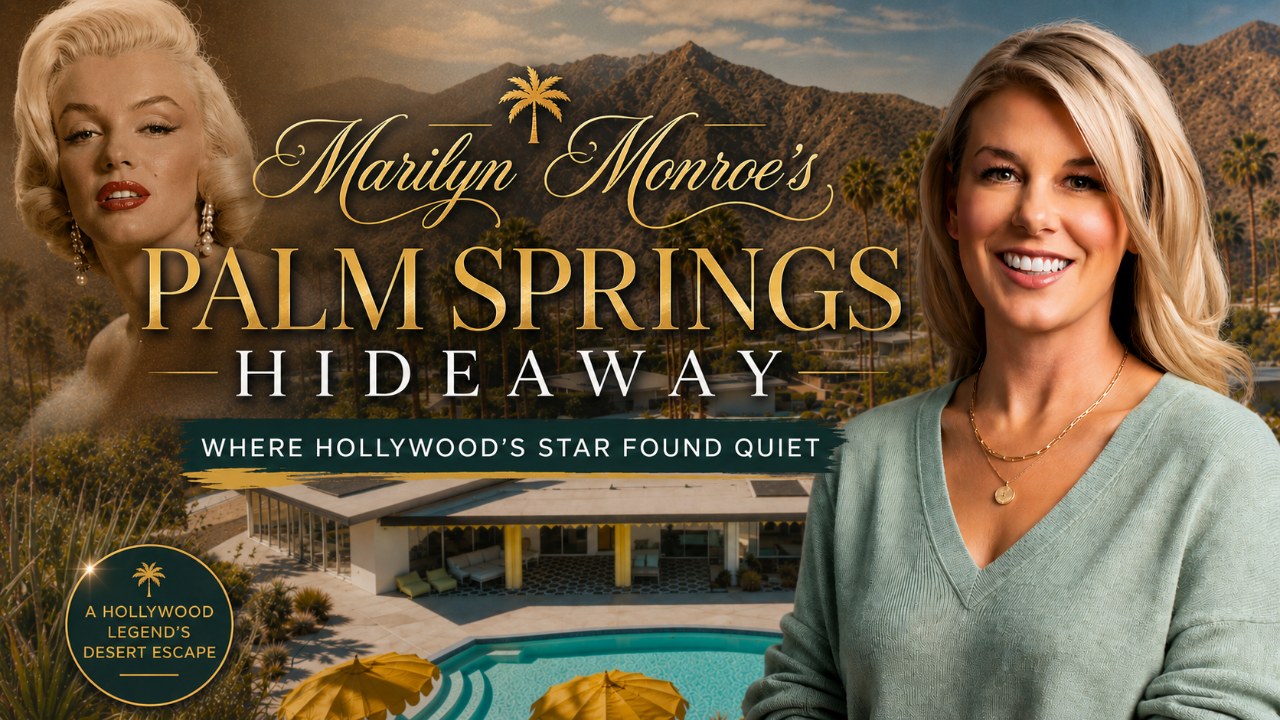
Marilyn Monroe's Palm Springs Hideaway — The Desert Escape Where Hollywood's Biggest Star Found Quiet
Where did Marilyn Monroe go when she needed to disappear?
She went to Palm Springs. Specifically, to a mid-century modern home at 1326 Rose Avenue — a quiet address where the world's most photographed woman could finally stop performing.
The year is 1955. Marilyn Monroe is the most famous person on the planet. Her face is on every magazine, her name in every gossip column. She can't walk through a lobby in New York or a studio lot in Hollywood without flashbulbs and shouted questions. But drive two hours east into the Coachella Valley, past the date palms and into the dry, clean heat of the desert, and something shifts. The air is different. So are the people. In Palm Springs, the unwritten rule was simple: you leave celebrities alone. It was a tradition as baked into the city's culture as the mid-century architecture lining every street.
Monroe knew it. And she took full advantage.
The House on Rose Avenue
The private residence at 1326 Rose Avenue became one of Monroe's most reliable sanctuaries throughout the 1950s and into the early 1960s. It was — and remains — a mid-century modern home, the kind of clean-lined, low-profile desert architecture that blends quietly into the landscape. No gates to announce you. No marquee. Just a pool, the sun, and the kind of silence that Hollywood simply couldn't offer.
Some of the most iconic casual photographs ever taken of Monroe came from Palm Springs. Poolside shots. Relaxed, unguarded, almost ordinary — which, for Marilyn Monroe, was extraordinary. Away from the set lights and the studio system, she looked like exactly what she was in those moments: a woman who simply wanted to swim and feel the sun on her face.
Her visits weren't solitary. Joe DiMaggio came to the desert with her during the years of their relationship and marriage. Arthur Miller visited too. The desert had a way of stripping things back to something honest — no pretense, no performance, just the mountains and the heat and the quiet that the Coachella Valley does better than almost anywhere on earth.
A City That Knew How to Keep a Secret
Palm Springs didn't become Hollywood's favorite retreat by accident. The city built its identity around a particular kind of discretion — the understanding that when someone came here to rest, you let them rest. It was a compact between the city and its famous visitors that kept the likes of Frank Sinatra, Bob Hope, Cary Grant, and yes, Marilyn Monroe, coming back decade after decade.
Monroe's visits to Palm Springs coincided with some of the most turbulent stretches of her career. She came here during her contract disputes with 20th Century Fox — battles that consumed 1962, the last year of her life. The desert offered a counterweight to all of that noise. You can almost picture her at the Rose Avenue pool: sunglasses, a glass of something cold, the San Jacinto Mountains rising up to the west like a wall between her and everything that was trying to claim her.
That image — the quiet, private Marilyn — is one most people never got to see. Palm Springs got to see it.
Why It Still Matters Today
Monroe's connection to Palm Springs isn't just a piece of trivia. It's a thread in the city's larger story — the reason people talk about Palm Springs differently than they talk about other desert cities. There's a sense of place here that goes beyond weather and walkability. The homes, the streets, the mid-century architecture: they all carry the weight of a genuinely golden era.
When buyers ask me why Palm Springs commands the prices it does, I often point to exactly this. It's not just a house in the desert. It's a house in this desert — the one where the 20th century's most luminous figures came to be human for a while. The address matters. The story embedded in the neighborhood matters. The culture of discretion and beauty and architectural intention that Monroe was drawn to? It's still here. You can still feel it on a quiet Tuesday morning when the mountains are sharp against a blue sky and the only sound is the wind moving through the palms.
Palm Springs doesn't just sell homes. It sells a piece of something that most cities can't manufacture: a genuine past worth living inside of.
What This Means For You
• History has real estate value. The legacy of old Hollywood glamour in Palm Springs is a legitimate part of the city's appeal — and it's reflected in buyer demand and pricing. This isn't nostalgia for its own sake; it's context for why the market holds.
• Mid-century modern architecture is the city's signature. The same design aesthetic that made homes like the one on Rose Avenue appealing to Monroe is what drives Palm Springs' architectural identity today. If you're drawn to that style, you're buying into a deep tradition.
• Palm Springs' culture of discretion persists. The city's long history of welcoming high-profile visitors quietly is part of its character — and part of why second-home buyers from Los Angeles, the Bay Area, and beyond continue to choose it over more visible destinations.
• The story behind a home matters. Whether or not a property has a celebrity connection, Palm Springs homes carry a sense of history that adds to the living experience. If that resonates with you, it's worth factoring into your search. Curious about what Palm Springs neighborhoods look like today? Explore Palm Springs real estate here.
The desert has always been good at keeping secrets. Marilyn Monroe knew it. And if you've ever stood beside a Palm Springs pool at dusk, the mountains going pink in the last light, you probably understand exactly why she kept coming back.
Ready to make your move in the Coachella Valley? Reach out to Shana Gates at Craft & Bauer. Contact Shana →
Frequently Asked Questions
Where did Marilyn Monroe stay in Palm Springs?
Marilyn Monroe stayed at a private residence at 1326 Rose Avenue in Palm Springs on multiple occasions throughout the 1950s and early 1960s. The home is a mid-century modern private residence that she used as a retreat from the media attention she faced in Hollywood and New York.
Why did celebrities like Marilyn Monroe escape to Palm Springs?
Palm Springs developed a long-standing culture of discretion toward its celebrity visitors — locals simply let famous guests live quietly, without intrusion. Combined with the desert's natural beauty, warm climate, and the privacy that mid-century modern homes with walled courtyards and pools offered, it became the preferred escape for Hollywood's biggest stars for decades.
Is Marilyn Monroe's Palm Springs house open to the public?
No — 1326 Rose Avenue is a private residence and is not open to the public. While Palm Springs has several historic celebrity homes that are celebrated as part of the city's architectural and cultural heritage, this particular property remains privately owned and should be respected accordingly.