
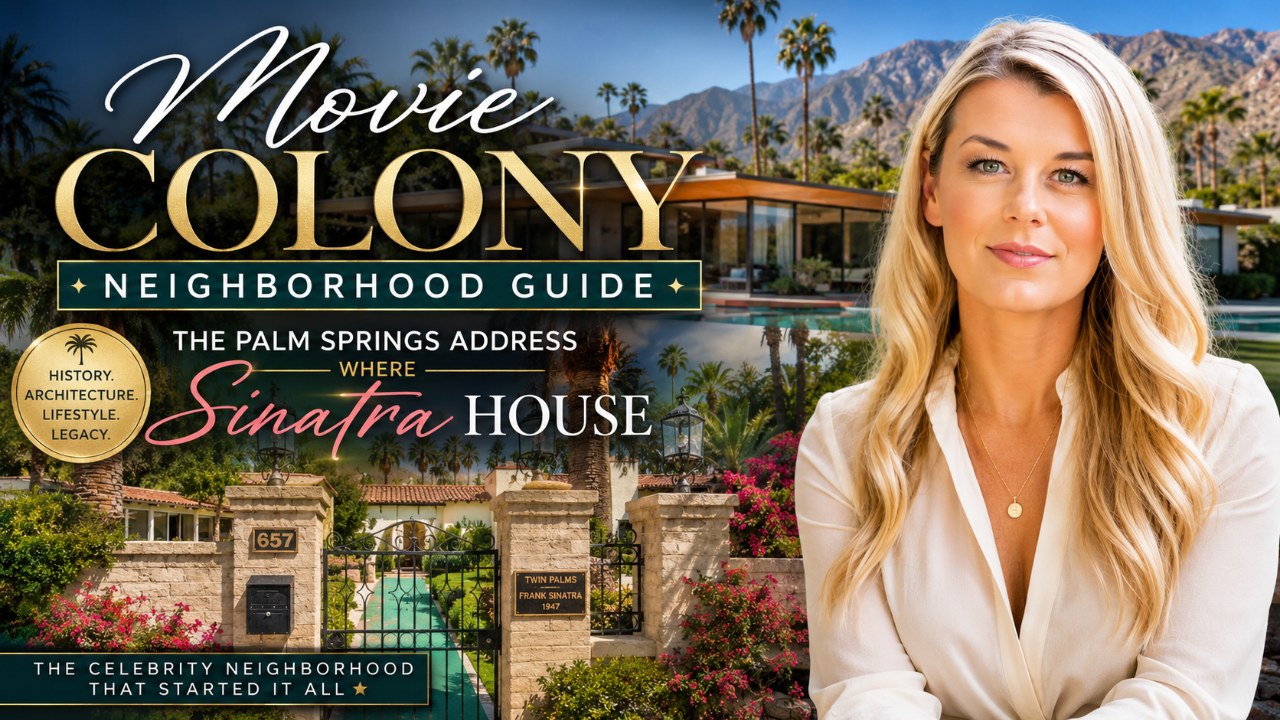
Movie Colony Palm Springs Neighborhood Guide: The Address Where Sinatra Built His Dream House
What is Movie Colony in Palm Springs, and why does it matter to buyers today?
Movie Colony is Palm Springs' original celebrity enclave — a mid-city neighborhood bounded by Alejo Road, Farrell Drive, Ramon Road, and Sunrise Way — where Hollywood's biggest names planted roots starting in the 1930s. It's home to some of the finest surviving Mid-Century Modern architecture in the Coachella Valley, including Frank Sinatra's iconic Twin Palms estate.
- A young, impossibly famous Frank Sinatra commissioned architect E. Stewart Williams to design a house in the California desert. Williams was just 30 years old. The result — a sprawling, piano-shaped pool, five-inch-thick concrete block walls, floor-to-ceiling glass, and a yellow-and-black color scheme — became one of the most photographed private residences in American history. Sinatra called it Twin Palms. The address: 1148 E. Alejo Road, right at the heart of what Palm Springs had already been calling Movie Colony for a decade.
The name wasn't a marketing invention. It was a description. By the late 1930s, so many studio stars, directors, and producers had bought or rented in this small pocket of desert that locals simply started calling it what it was.
Hollywood Comes to the Desert: How Movie Colony Got Its Name
The draw was simple and practical. Los Angeles studios had a rule: contract players couldn't travel more than two hours from the studio lot without permission. Palm Springs sat right at that outer edge. It was close enough for the weekend, far enough to feel like another world, and — crucially — hot enough in summer to keep the press corps home in LA.
Word spread fast. Cary Grant rented here. Humphrey Bogart and Lauren Bacall made it a regular retreat. Marilyn Monroe spent time in the neighborhood before she became Marilyn Monroe. The stars didn't just vacation here — they showed up for weeks at a stretch, threw parties, and, in Sinatra's case, put down permanent roots. Twin Palms was Sinatra's primary desert residence through his marriage to Ava Gardner, and the couple's legendary fights and reconciliations reportedly echoed off those concrete block walls with some regularity.
What made Movie Colony different from other Palm Springs addresses wasn't just the celebrity wattage — it was the architecture. Because so many of these homes were built or renovated between the late 1940s and early 1960s, the neighborhood became an accidental museum of Mid-Century Modern design. E. Stewart Williams, William Krisel, and their contemporaries left behind a streetscape that still stops you cold today.
Twin Palms and the Architecture That Outlasted the Stars
E. Stewart Williams went on to design several other landmark Palm Springs buildings, but Twin Palms remains his calling card. The home exemplifies what made desert MCM so distinct: an honest response to climate and site. Wide roof overhangs for shade. Walls that opened to the outdoors. A relationship between interior and exterior that dissolved the boundary between them. The piano-shaped pool wasn't just a flex — it was Sinatra's nod to the music that paid for all of it.
The home is still standing at 1148 E. Alejo Road and is available for short-term rental, which means you can actually spend the night there. Walking through it, you understand immediately why the neighborhood earned its historic designation. Parts of Movie Colony now carry Class 2 historic district status under Palm Springs' local preservation program — a formal acknowledgment that what's here is worth protecting.
That designation matters for buyers in a very practical way. Historic status can affect what modifications are permitted, but it also provides a layer of protection against the teardowns and McMansion replacements that have altered other parts of the valley. In Movie Colony, the bones of the neighborhood are largely intact because the city has made a deliberate choice to keep them that way.
What the Movie Colony Palm Springs Neighborhood Looks Like Today
The Movie Colony Palm Springs neighborhood today is a walkable, mid-city pocket with a residential character, tree-lined streets and established landscaping — but downtown Palm Springs is genuinely close. The shops, restaurants, and energy of Palm Canyon Drive are about a 10-minute walk or a three-minute drive from most addresses in the neighborhood. That combination — architectural significance, proximity to amenities, and a relatively contained footprint — is rare in the Coachella Valley.
Home prices in Movie Colony currently range from roughly $800,000 on the lower end to $3 million and above for fully restored, architecturally significant estates. The market here is driven heavily by buyers who understand what they're looking at: people who've done their research on MCM architects, who care about original details like terrazzo floors and clerestory windows, and who want an address with a genuine story behind it. This isn't a neighborhood where you buy despite the history — you buy because of it.
Short-term rental demand is strong in this part of Palm Springs, and the city's STR permitting framework applies here as it does across the city. If you're considering a purchase with vacation rental income in mind, that's a conversation worth having early in your search — Palm Springs requires a permit and collects Transient Occupancy Tax (TOT) on rental income, and occupancy rules matter for historic properties specifically.
Why It Still Matters Today
Movie Colony's history isn't just a fun trivia layer — it's baked into the value of every home on these streets. The Class 2 historic district designation protects architectural character. The Sinatra connection and MCM legacy drive ongoing tourism and short-term rental demand. And the walkability to downtown Palm Springs gives the neighborhood a livability score that many newer desert communities simply can't match.
For buyers considering Palm Springs, Movie Colony is one of those rare addresses where you can own something that genuinely cannot be replicated. The lots are established, the architecture is protected, the history is documented, and the street-level experience of the neighborhood — wide lots, mature landscaping, and tree-lined streets — reflects decades of care.
What This Means For You
• Historic designation adds a layer of protection. Class 2 historic status in parts of Movie Colony limits the kind of alterations that can erase architectural character — which helps preserve long-term value.
• Proximity to downtown is a real asset. The neighborhood sits within easy walking or biking distance of Palm Canyon Drive's restaurants, boutiques, and nightlife — without being directly in the tourist corridor.
• Price range reflects the pedigree. Expect $800K–$3M depending on size, condition, original details, and renovation quality. Fully restored, architect-documented homes command a significant premium.
• STR feasibility is real, but requires due diligence. Palm Springs has an active short-term rental market, but permitting, TOT obligations, and any historic property-specific restrictions need to be verified before you buy.
Movie Colony is the kind of neighborhood that rewards buyers who show up informed. If you've been searching for a Palm Springs address with genuine architectural and historical depth — not just desert views and a pool — this is where that search tends to end.
Ready to make your move in the Coachella Valley? Reach out to Shana Gates at Craft & Bauer. Contact Shana →
Frequently Asked Questions
Where exactly is Movie Colony in Palm Springs?
Movie Colony is a mid-city Palm Springs neighborhood bounded by Alejo Road to the north, Farrell Drive to the east, Ramon Road to the south, and Sunrise Way to the west. It sits roughly a mile east of downtown Palm Springs and Palm Canyon Drive, making it one of the more centrally located residential neighborhoods in the city.
Can you visit Frank Sinatra's Twin Palms estate in Movie Colony?
Yes — Twin Palms at 1148 E. Alejo Road is available as a short-term vacation rental, meaning you can book a stay and experience the home firsthand. The estate retains much of its original E. Stewart Williams design, including the distinctive piano-shaped pool, and is one of the most recognizable Mid-Century Modern properties in the Coachella Valley.
What are home prices like in Movie Colony Palm Springs?
Homes in the Movie Colony Palm Springs neighborhood currently range from approximately $800,000 to $3 million or more, depending on lot size, architectural significance, original details, and the quality of any renovations. Fully restored Mid-Century Modern estates with documented architectural provenance tend to command the highest prices in this range.