
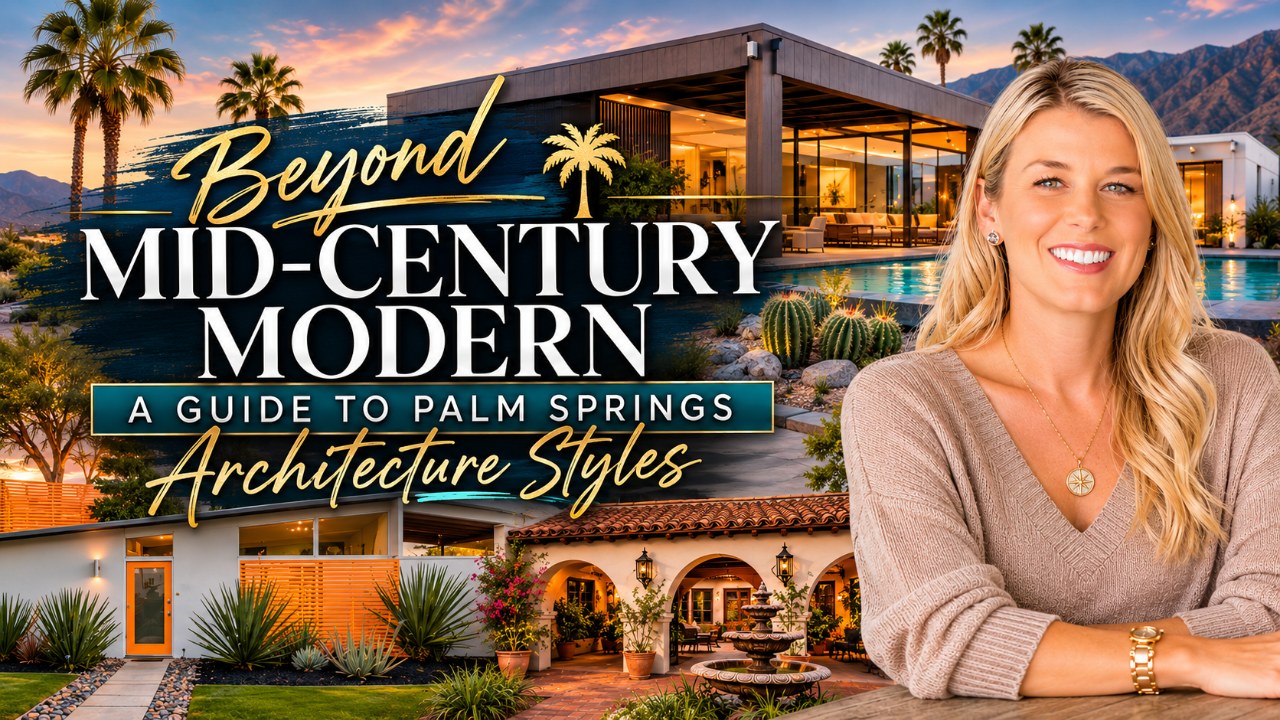
Beyond Mid-Century: A Palm Springs Architectural Styles Guide
What architectural styles will you actually find in Palm Springs — beyond Mid-Century Modern?
Palm Springs is home to at least five distinct architectural traditions: Spanish Colonial Revival, Mid-Century Modern, Pueblo Revival, Hacienda, and Modern Desert Contemporary. Each style clusters in specific neighborhoods and carries its own price profile, renovation logic, and lifestyle character.
Spanish Colonial Revival and Hacienda: The City's Oldest Layer
Before the architects of the Case Study era arrived, Palm Springs was already taking shape in the 1920s and 1930s under the influence of Spanish Colonial Revival design. You'll recognize it by its red clay tile roofs, stucco exteriors, arched doorways, wrought-iron details, and central courtyard layouts built around shade and airflow — practical responses to desert heat long before air conditioning.
Hacienda-style homes share that same DNA but tend to be larger, more compound-like in their massing, and often organized around an interior garden or pool courtyard. Both styles concentrate in the older sections of the Tennis Club neighborhood and in pockets of the Historic Tennis Club District, where some of the city's earliest resort-era estates still stand.
For buyers, these homes offer genuine character and thick-wall construction that naturally moderates interior temperatures. They also come with a specific renovation calculus: matching period tile, sourcing period-appropriate ironwork, and navigating potential historic overlay review if the home carries any Mills Act or Class 1 designation.
Pueblo Revival: Desert Vernacular With Southwestern Roots
Pueblo Revival borrows from the adobe building traditions of the American Southwest — flat or slightly pitched roofs, rounded parapet walls, exposed wooden vigas (roof beams), and earth-toned stucco that reads almost as an extension of the landscape. In Palm Springs, you'll find this style scattered through older residential corridors and occasionally as the architectural language of small commercial buildings and boutique inns from the mid-20th century.
These homes tend to sit on larger lots, blend well with native desert landscaping, and feel connected to the terrain in a way that other styles don't. If low-water landscaping and a home that disappears into its surroundings appeal to you, Pueblo Revival is worth knowing by name — because it doesn't always show up under that label in listing descriptions.
Palm Springs Architectural Styles Guide: Modern Desert Contemporary
The newest chapter in this Palm Springs architectural styles guide is what the market calls Modern Desert or Desert Contemporary — a style that has exploded since the 2000s and now defines much of the new construction and luxury spec market. Think clean horizontal lines, floor-to-ceiling glass walls, steel and concrete, seamless indoor-outdoor transitions, and a deliberate visual conversation with the mountain views surrounding the valley.
You'll find Desert Contemporary concentrated in newer developments on the north and south ends of the city, in Arenas Road-adjacent luxury infill, and in custom builds throughout unincorporated desert-adjacent parcels. These homes are engineered for modern desert living — solar-ready, pool-centric, with open-plan interiors that orient toward outdoor living for roughly eight months of the year.
The short-term rental market in Palm Springs tends to respond very well to Desert Contemporary homes, which photograph dramatically and appeal to the design-forward visitor the city increasingly attracts.
What This Means For You
• Matching style to budget: Spanish Colonial and Pueblo Revival homes often offer lower entry points with significant character upside — but budget for period-appropriate restoration, not just cosmetic updates.
• Historic designations matter: Some Spanish Colonial and early MCM properties carry Mills Act contracts that can mean significant property tax savings — but also design restrictions. Ask specifically before writing an offer.
• Desert Contemporary = strong STR performance: If short-term rental income is part of your investment thesis, Desert Contemporary homes tend to outperform on platforms like Airbnb and VRBO due to visual appeal and modern amenity expectations. Always verify current Palm Springs STR permit requirements before purchasing.
• Neighborhood-style alignment: Knowing the dominant architectural language of a neighborhood helps you understand what renovations will blend in, what won't, and what comparable sales actually reflect.
Whether you're drawn to the courtyard romance of a 1930s Spanish Colonial or the glass-and-mountain-view drama of a new Desert Contemporary build, Palm Springs rewards buyers who understand what they're looking at. This city's architectural range is one of its genuine strengths — and one of the reasons it attracts buyers from across the country year after year.
Ready to make your move in the Coachella Valley? Reach out to Shana Gates at Craft & Bauer — she knows this market inside and out. Contact Shana →
Frequently Asked Questions
What is the most common architectural style in Palm Springs?
Mid-Century Modern remains the most widely recognized and heavily documented style in Palm Springs, concentrated in neighborhoods like the Movie Colony, Vista Las Palmas, and the Racquet Club Estates. However, Spanish Colonial Revival and newer Desert Contemporary homes collectively represent a significant share of the city's housing stock.
Are Spanish Colonial Revival homes in Palm Springs historically protected?
Some are. Palm Springs has a robust historic preservation program, and certain Spanish Colonial Revival properties — particularly in the Tennis Club neighborhood — may carry Class 1 Historic Site designation or participate in the Mills Act program. A Mills Act contract can reduce property taxes substantially but does come with design and maintenance obligations reviewed by the city's Historic Site Preservation Board.
What's the difference between Modern Desert and Mid-Century Modern architecture in Palm Springs?
Mid-Century Modern (roughly 1945–1975) is characterized by flat or butterfly rooflines, post-and-beam construction, clerestory windows, and an integration of indoor and outdoor space rooted in optimism-era American design. Modern Desert Contemporary (2000s–present) shares the indoor-outdoor ethos but leans into current materials — steel, concrete, glass curtain walls — and is typically engineered around contemporary sustainability standards like solar and energy efficiency. Both styles celebrate the desert landscape, but MCM is a historical style while Desert Contemporary is an evolving one.