
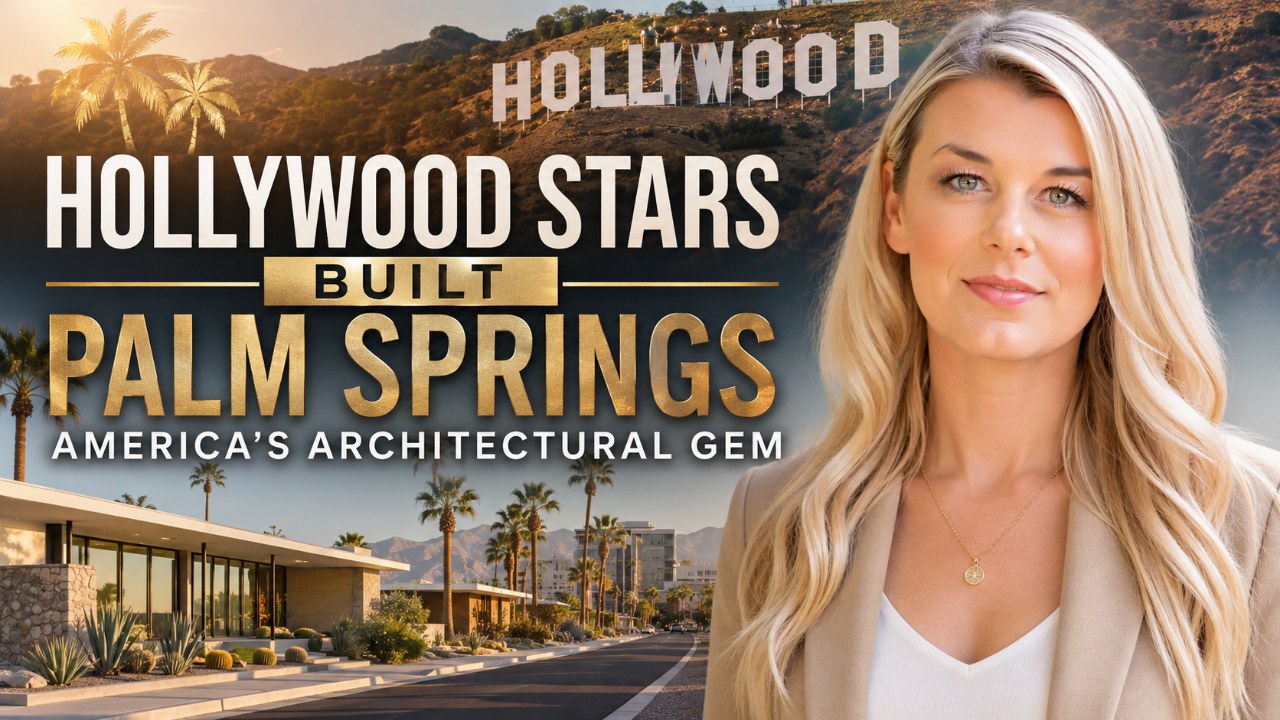
How Hollywood Celebrities Accidentally Created the Most Architecturally Valuable Neighborhood in America
Why do mid-century modern homes in Palm Springs sell for $800K to $5 million — sometimes more — when comparable square footage anywhere else might fetch a fraction of that price?
Because the people who built them weren't building houses. They were building escapes — and they hired the greatest architects alive to do it.
A Friday Night in 1946, on West Vista Chino
Picture this: a flat-roofed steel-and-glass rectangle rising from the desert floor at 470 W Vista Chino in Palm Springs. No grand entry gate. No imposing columns. Just a building that seems to dissolve into the landscape — the San Jacinto Mountains framing the view through walls of glass like a living painting.
Richard Neutra completed the Kaufmann Desert House in 1946 for Pittsburgh department store heir Edgar Kaufmann Sr., the same patron who'd commissioned Frank Lloyd Wright's Fallingwater a decade earlier. Kaufmann wasn't slumming it in the desert. He wanted the best. And the result was one of the most photographed, studied, and coveted residential structures ever built on American soil. In 2022, it sold for approximately $25 million.
That one transaction tells you almost everything you need to know about Palm Springs mid-century modern architecture and the celebrity history behind it.
The Perfect Storm: Hollywood Money, Desert Sun, and a Handful of Geniuses
The years between roughly 1935 and 1970 were a collision of circumstances that would never happen quite the same way again. Hollywood studio contracts kept stars within a two-hour drive of Los Angeles — close enough to report for Monday filming, far enough to truly disappear for the weekend. Palm Springs was the answer.
Frank Sinatra commissioned E. Stewart Williams to design Twin Palms in 1947. Williams also designed the Edris House, a quietly stunning residence that remains one of the valley's most admired properties. Albert Frey — a Swiss-born modernist who'd trained under Le Corbusier — planted himself here permanently and built his own Frey House II literally into the granite boulders above the valley floor. He later designed Palm Springs City Hall and the Tramway Valley Station, structures you can still visit today.
Then there was John Lautner, who designed the Bob Hope Estate in the early 1970s — a volcanic concrete form so otherworldly it looks like it landed here from another planet. And Donald Wexler, who built experimental steel-framed homes that pushed the boundaries of what residential construction could even attempt in a desert climate.
What made Palm Springs different from every other place these architects worked wasn't just the clients' budgets — it was the density. In most American cities, a Neutra house sits in a neighborhood of conventional construction. Here, masterwork after masterwork landed within a few square miles of one another, creating a living museum of mid-century modern architecture that has no parallel anywhere in the country.
The Alexander Houses: When Genius Went to Scale
Not every piece of Palm Springs mid-century modern architecture came with a celebrity commission. Some of it came from a developer who had the vision — and the sense — to hire the right architect and then get out of the way.
Between 1955 and 1965, the Alexander Construction Company built more than 2,000 homes in Palm Springs. Developer George Alexander paired with architect William Krisel to produce entire tracts of homes defined by clean lines, clerestory windows, and Krisel's signature butterfly roof — that distinctive inverted-V silhouette you'll recognize the moment you drive through the Twin Palms or Vista Las Palmas neighborhoods.
At the time, these were tract homes. Affordable, production-built, meant for regular people who wanted desert living without a celebrity budget. Today, those same homes sell for $600,000 to $2 million, and buyers compete fiercely for the ones with original details intact. What felt ordinary in 1960 is now recognized as some of the most thoughtfully designed residential architecture ever produced at scale in America.
The Palm Springs Preservation Foundation has designated over 100 individual properties as historic sites, and the city's Historic Site Designation Program continues to expand that list. Modernism Week, held every February, draws more than 150,000 visitors specifically to experience this architecture — making it one of the most attended architecture events in the United States.
Why It Still Matters Today
The Palm Springs mid-century modern architecture celebrity history isn't just interesting trivia. It's the foundation of the entire premium real estate market here.
What This Means For You
• Provenance drives price. A Krisel-designed Alexander home with original butterfly roof and documented history commands a significant premium over an architecturally similar but undocumented property — sometimes 30–50% more. When you're buying in Palm Springs, you're often buying a piece of a documented design legacy.
• Historic designation is a double-edged sword. City historic designation can protect a home's character and support its long-term value, but it also restricts modifications. If you're buying a designated property, understand what you can and cannot change before you close.
• The $25M Kaufmann sale set a new ceiling. That 2022 transaction wasn't an outlier — it was a signal. Architecturally significant properties in Palm Springs now attract national and international buyers who see them as assets, not just homes. That competition trickles down through the entire market.
• Modernism Week matters to your investment. More than 150,000 visitors arriving every February to tour mid-century homes means sustained cultural relevance — and sustained buyer demand — for this type of property year after year.
Understanding this history isn't just satisfying to know. It's genuinely useful if you're considering buying in Palm Springs. When an agent tells you a home has "architectural significance," now you know exactly what that means, where it comes from, and why it's worth what the market says it's worth.
Ready to make your move in the Coachella Valley? Reach out to Shana Gates at Craft & Bauer. Contact Shana →
Frequently Asked Questions
What architects are most associated with Palm Springs mid-century modern history?
The most celebrated names are Richard Neutra, Albert Frey, William Krisel, Donald Wexler, E. Stewart Williams, and John Lautner. Each left a significant body of work in Palm Springs that is now studied internationally and designated for historic preservation. Krisel alone, through his partnership with the Alexander Construction Company, is responsible for thousands of homes that define the look of entire Palm Springs neighborhoods today.
How much do mid-century modern homes in Palm Springs actually sell for?
Prices range widely based on architect, condition, historic designation status, and documentation. William Krisel–designed Alexander homes typically sell in the $600,000–$2 million range, while architect-designed one-off commissions can reach $5 million and beyond. The Kaufmann Desert House, designed by Richard Neutra, sold for approximately $25 million in 2022, setting a benchmark for the most significant properties in the valley.
What is Modernism Week in Palm Springs?
Modernism Week is an annual event held every February in Palm Springs that celebrates mid-century modern architecture, design, and culture. It draws more than 150,000 attendees and features home tours, lectures, film screenings, and design exhibitions. It has become one of the most-attended architecture events in the United States and is a major driver of cultural interest — and buyer demand — for mid-century properties in the Coachella Valley.