
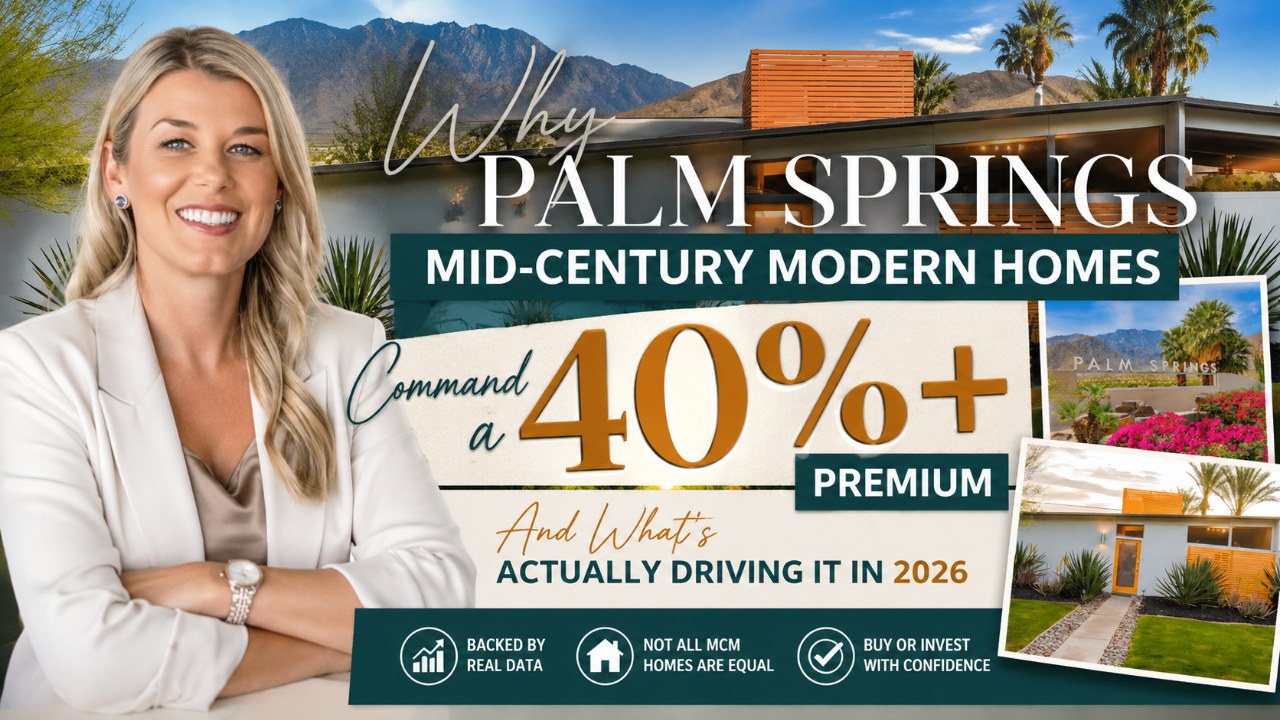
Are Palm Springs mid-century modern homes really worth the premium — or are buyers just paying for the aesthetic?
The premium is real and quantifiable. Palm Springs MCM homes consistently sell 40% or more above comparable non-MCM properties in the same neighborhoods — and specific, measurable factors determine exactly how wide that gap gets. Here's what's actually driving the numbers in 2026.
What the Data Says About Palm Springs Mid-Century Modern Homes
The MCM premium isn't uniform — it's a spectrum that starts at roughly 40% above non-MCM comparables and climbs steeply from there. In established MCM corridors like Movie Colony, Twin Palms, and Vista Las Palmas, the spread between a well-preserved mid-century home and a conventional property of similar square footage is significant and consistent. Alexander Construction tract homes — the accessible entry point into the MCM market — now trade in the $600K–$2M+ range depending on condition, updates, and lot orientation. That's a far cry from the $25,000–$35,000 they sold for when new, and it reflects genuine, sustained demand rather than a trend.
That demand has a measurable cultural engine behind it: Modernism Week draws over 150,000 visitors to Palm Springs each February, creating a recurring global spotlight on the city's architectural heritage. Serious buyers — including international investors — time purchasing decisions around that event. When 150,000 architecture enthusiasts descend on a city with a finite supply of historic homes, prices don't soften.
The Four Factors That Actually Set the Price
Named architect is the single most powerful premium driver. Homes attributed to Richard Neutra command 2–3x the price of a non-architect MCM of similar size and condition — the 2022 sale of the Kaufmann Desert House at approximately $25 million is the extreme end of that spectrum, but the multiplier holds at every price point. Albert Frey homes carry a 1.5–2x premium. E. Stewart Williams, Donald Wexler, William Cody — all move the needle meaningfully. If the architect can be verified through documentation, that documentation is worth real money.
Historic designation is the second major factor. Palm Springs administers a two-tier Class 1 (individually significant) and Class 2 (contributor to a historic district) designation system. Class 1 designation correlates with materially higher sale prices; it also signals that the architectural integrity has been vetted and preserved, which matters enormously to buyers who will pay a premium but won't tolerate compromised details. Buyers should understand that designation also comes with renovation restrictions — which is actually a feature for investors concerned about neighboring properties being altered.
Neighborhood and provenance round out the picture. Vista Las Palmas is known for its architect-designed originals, including William Krisel's Alexander Construction homes and Charles DuBois's rare Swiss Miss A-frames. Twin Palms — designed largely by Palmer & Krisel for the Alexander Construction Company — offers a slightly more accessible entry point with strong rental appeal and high architectural coherence. Movie Colony, with its history of celebrity ownership, carries a provenance premium that overlaps with but is distinct from the pure architectural premium.
What This Means For You
• Named-architect documentation matters more than you think. Before closing on any MCM home in Palm Springs, verify the attribution through city records, the Architecture and Historic Preservation department, or the Palm Springs Preservation Foundation. Unverified "attributed to" claims do not command the same price — and shouldn't.
• Historic designation is a hedge, not just a trophy. Class 1 and Class 2 designations limit what owners can do to a property — but they also limit what neighbors can do. For buyers and investors who value architectural integrity, that restriction is a form of protection.
• The Alexander tract is the most accessible entry point with real upside. At $600K–$2M+, Palmer & Krisel–designed Alexander homes offer genuine MCM credentials, strong short-term rental demand, and a buyer pool that only grows as Modernism Week expands.
• If you're asking "am I overpaying?" — run the comp analysis against non-MCM in the same neighborhood first. A 40% premium over non-MCM isn't overpaying if the market consistently delivers it. The question is whether the specific home is priced correctly within the MCM tier — that's where the analysis gets granular.
The MCM market in Palm Springs rewards buyers who do their homework and punishes those who rely on emotion alone. Knowing which lever — architect, designation, neighborhood, provenance — is moving the price on a specific property is the difference between a confident offer and an expensive lesson.
Ready to make your move in the Coachella Valley? Reach out to Shana Gates at Craft & Bauer — she knows this market inside and out. Contact Shana →
Frequently Asked Questions
How much more do Palm Springs mid-century modern homes sell for compared to non-MCM properties?
Palm Springs MCM homes typically sell for 40% or more above non-MCM properties of comparable size and location in the same neighborhood. That premium rises sharply for homes with verified named-architect attribution — Richard Neutra properties, for example, have historically commanded 2–3x the price of similar non-architect MCM homes.
Does historic designation affect what I can do with a Palm Springs MCM home?
Yes — Palm Springs Class 1 and Class 2 historic designations come with design review requirements for exterior alterations, meaning changes to the facade, roofline, windows, and other character-defining features require city approval. For buyers focused on preservation, this is often a benefit rather than a burden, since it protects the home's value against unsympathetic modifications by future owners.
Are Palm Springs mid-century modern homes good short-term rental investments?
Many MCM homes in Palm Springs perform well as short-term rentals, particularly in neighborhoods like Twin Palms and the Alexander tracts, where architectural character drives strong guest demand. Palm Springs requires a short-term rental permit and collection of Transient Occupancy Tax (TOT), so any investor should verify current permit availability and city regulations before purchasing with STR income as part of the underwriting.