
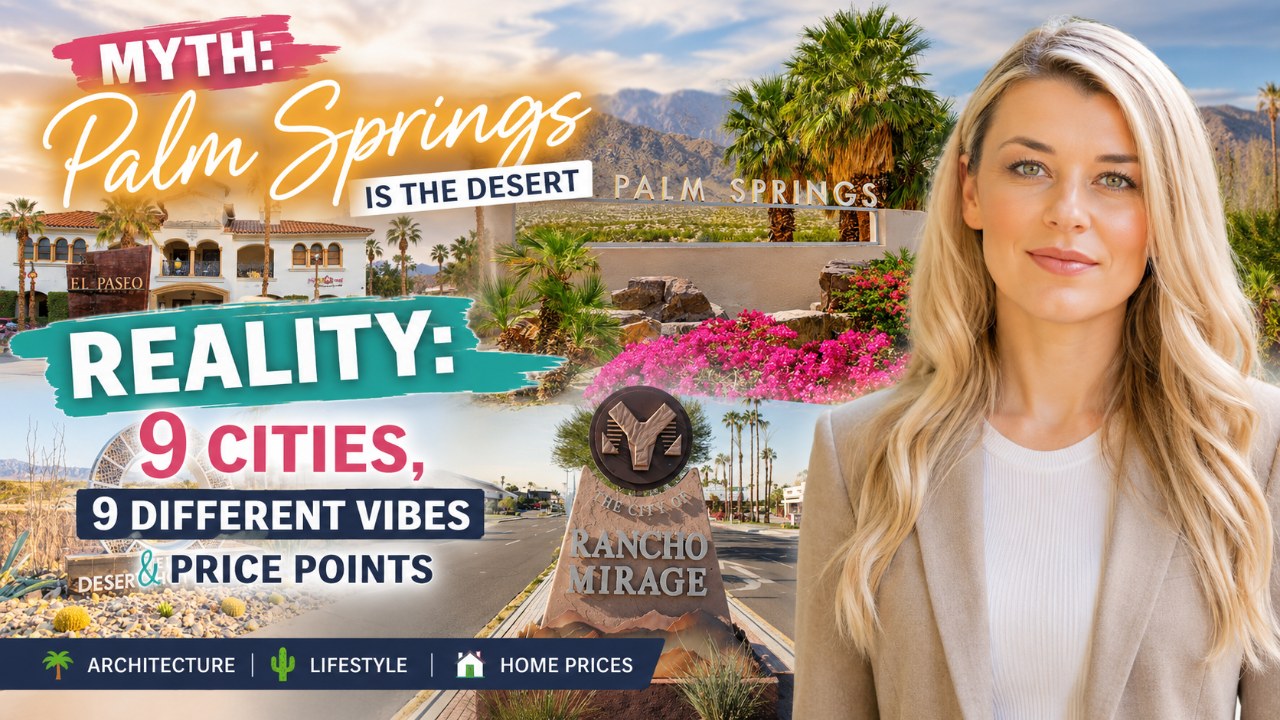
Myth: Palm Springs Is the Coachella Valley. Reality: 9 Cities, Each With Its Own Vibe and Price Point
Is Palm Springs the same as the Coachella Valley?
No — Palm Springs is one of nine incorporated cities in the Coachella Valley. While "Palm Springs" has become shorthand for the entire desert region, each city has its own character, price range, zoning rules, and buyer profile. Knowing the difference could save you from buying in the wrong place — or help you find the right one.
Here's how it usually goes. Someone tells you they're thinking of buying "out in Palm Springs." You ask where, exactly. They pause. "You know — the desert. Near Coachella." And that's when you realize they don't mean Palm Springs the city at all. They mean the whole valley.
It's an incredibly common mix-up, and it's not entirely their fault. Palm Springs has the name recognition — the mid-century modern architecture, the Rat Pack mythology, the magazine spreads. But the Coachella Valley stretches roughly 45 miles from Desert Hot Springs in the northwest to the city of Coachella in the southeast. Nine incorporated cities. Nine different personalities. Price points that range from $200,000 to well north of $5,000,000. The Palm Springs vs Coachella Valley cities question isn't just a geography lesson — it's the most important orientation any desert buyer can get.
Let me take you through all nine.
The Western Valley: Iconic, Affordable, and Everything In Between
Myth: The western valley is just Palm Springs.
Reality: Four cities, four completely different buyer experiences.
Palm Springs is the headliner — and for good reason. The city's grid of Kaufmann Houses, Alexander homes, and Wexler steel-framed gems draws architecture enthusiasts from around the world. It's walkable (by desert standards), has a vibrant restaurant and arts scene, and sits at roughly $450,000 to $2M+ across its diverse neighborhoods. It's also one of the strongest short-term rental markets in California, though the city requires a permit and the collection of Transient Occupancy Tax from every booking. If STR income is part of your investment thesis, Palm Springs is worth the permit paperwork.
Just north, Desert Hot Springs is the valley's most attainable market — medians starting around $200,000 and topping out near $500,000. The city sits above the Coachella Valley on a mesa with sweeping views south toward the San Jacinto Mountains. Its namesake hot mineral springs have fueled a quiet spa resort scene for decades, and a wave of creative buyers have been quietly discovering it for years. If your budget is tight and you want to own in the desert, Desert Hot Springs deserves a serious look.
Cathedral City sits tucked between Palm Springs and Rancho Mirage — geographically central, often overlooked. Home prices run roughly $300,000 to $700,000, making it one of the more budget-accessible options in the mid-valley corridor. It has its own downtown revitalization story, its own distinct neighborhoods, and a lot of square footage for the dollar compared to its neighbors. Buyers who want proximity to Palm Springs without Palm Springs prices consistently find value here.
Then there's Rancho Mirage — and the tone shifts entirely. This is old-school desert luxury. Gated communities, manicured golf courses, and a residential history that reads like a Hollywood A-list. Betty Ford called it home. Presidents have visited. Medians start around $600,000 and climb past $3M in the prestige enclaves. One important note for investors: Rancho Mirage prohibits most short-term rentals. It is emphatically a primary residence and long-term market, and buyers should go in with that understanding.
The Mid-Valley: Golf, Glamour, and the Valley's Beating Heart
Myth: Palm Desert is just a bigger Palm Springs.
Reality: It's the valley's most diverse and commercially complete city — on its own terms.
Palm Desert is the largest city in the Coachella Valley by population and arguably the most well-rounded. El Paseo — nicknamed the "Rodeo Drive of the Desert" — anchors a shopping and dining district that stretches for miles. The McCallum Theatre, College of the Desert, and Desert Willow Golf Resort all call Palm Desert home. Price points run $400,000 to $1.5M+, spanning everything from entry-level condos to estate homes in South Palm Desert. It's also one of the few valley cities where you can find walkable errands, a gym, a concert, and a mountain hike all within a few miles of each other.
Indian Wells is in a category of its own. With the lowest residential density of any city in the valley and home prices spanning $700,000 to over $5M, it's the quiet ultra-luxury anchor of the mid-valley. Indian Wells is the permanent home of the BNP Paribas Open — one of the largest tennis tournaments in the world — and residents enjoy deeply subsidized access to local amenities as a result. You won't find many rentals, short-term or otherwise. What you will find is meticulously maintained estates, world-class golf, and the kind of silence that comes with very large lots and very deliberate zoning.
The East Valley: Value, Scale, and the Festival Effect
Myth: The east valley is too far out — it's not really "the desert."
Reality: It's where the Coachella Valley started, and it's where some of the smartest buyers are looking right now.
La Quinta often surprises people. It has the amenities of a luxury resort city — PGA West, SilverRock, Old Town La Quinta's charming plaza — but a price range ($500,000 to $2.5M+) that feels more accessible than Indian Wells or Rancho Mirage. La Quinta has a tiered STR permit system, which means short-term rental opportunities exist here, particularly in golf-course and resort communities. It's one of the most active buyer markets in the valley, and for good reason: it delivers a high quality of life across a wide range of budgets.
Indio is the host city for Coachella and Stagecoach — two of the largest music festivals in the world — and that concert-weekend rental demand is real and quantifiable. Outside of festival season, Indio is the most affordable incorporated city in the mid-to-east valley corridor, with homes ranging from roughly $300,000 to $800,000. It's a working city with deep agricultural roots, a growing residential base, and some of the best value per square foot in the valley.
Finally, the city of Coachella — the namesake of the whole valley — anchors the southeastern end. Home prices generally run $250,000 to $600,000, and the city has seen meaningful new development over the past decade. Its agricultural heritage is still visible in its grid of date palm groves and farmland at the city's edges, and its residents reflect a community that has been here long before the festival made the name famous worldwide.
What This Means For You
• Don't shop "the desert" — shop the city. Each of the nine cities has different STR rules, HOA cultures, price floors, and community amenities. Buying in the wrong city for your goals (investment vs. primary vs. second home) is a costly mistake.
• The Palm Springs vs Coachella Valley cities question is a real buyer filter. If STR income matters to you, Palm Springs, La Quinta, and Indio are the cities to focus on. If you want luxury without rentals next door, look at Rancho Mirage and Indian Wells.
• Budget goes further as you move east and north. Desert Hot Springs and Coachella offer ownership opportunities at price points that simply don't exist in Palm Springs or Palm Desert — and both have compelling long-term stories.
• Local expertise matters more here than almost anywhere. These cities are physically close but legally and culturally distinct. An agent who knows the whole valley — not just one zip code — will save you time, money, and surprises at the permit desk.
The Coachella Valley isn't a place you can understand from the outside. It rewards the people who take the time to know it city by city, neighborhood by neighborhood. That's the orientation every desert buyer deserves — and now you have it.
Ready to make your move in the Coachella Valley? Reach out to Shana Gates at Craft & Bauer. Contact Shana →
Frequently Asked Questions
What is the difference between Palm Springs and the Coachella Valley?
Palm Springs is a single incorporated city within the larger Coachella Valley region, which spans roughly 45 miles and includes nine distinct cities: Palm Springs, Desert Hot Springs, Cathedral City, Rancho Mirage, Palm Desert, Indian Wells, La Quinta, Indio, and Coachella. When people say "Palm Springs" colloquially, they often mean the broader desert region — but each city has its own government, zoning laws, price range, and character.
Which Coachella Valley city is best for short-term rental investment?
Palm Springs, La Quinta, and Indio are generally the strongest cities for short-term rental (STR) investment, each with permit systems that allow properly licensed rentals. Rancho Mirage, by contrast, prohibits most STRs. STR rules vary significantly across all nine cities, so verifying current ordinances before purchasing for rental income is essential.
Which Coachella Valley city is most affordable for buyers?
Desert Hot Springs and Coachella are currently the most attainable markets in the valley, with home prices starting as low as $200,000–$250,000. Indio and Cathedral City also offer strong value relative to their mid-valley neighbors. Affordability does shift with market conditions, so checking current inventory with a local agent gives you the most accurate picture.