
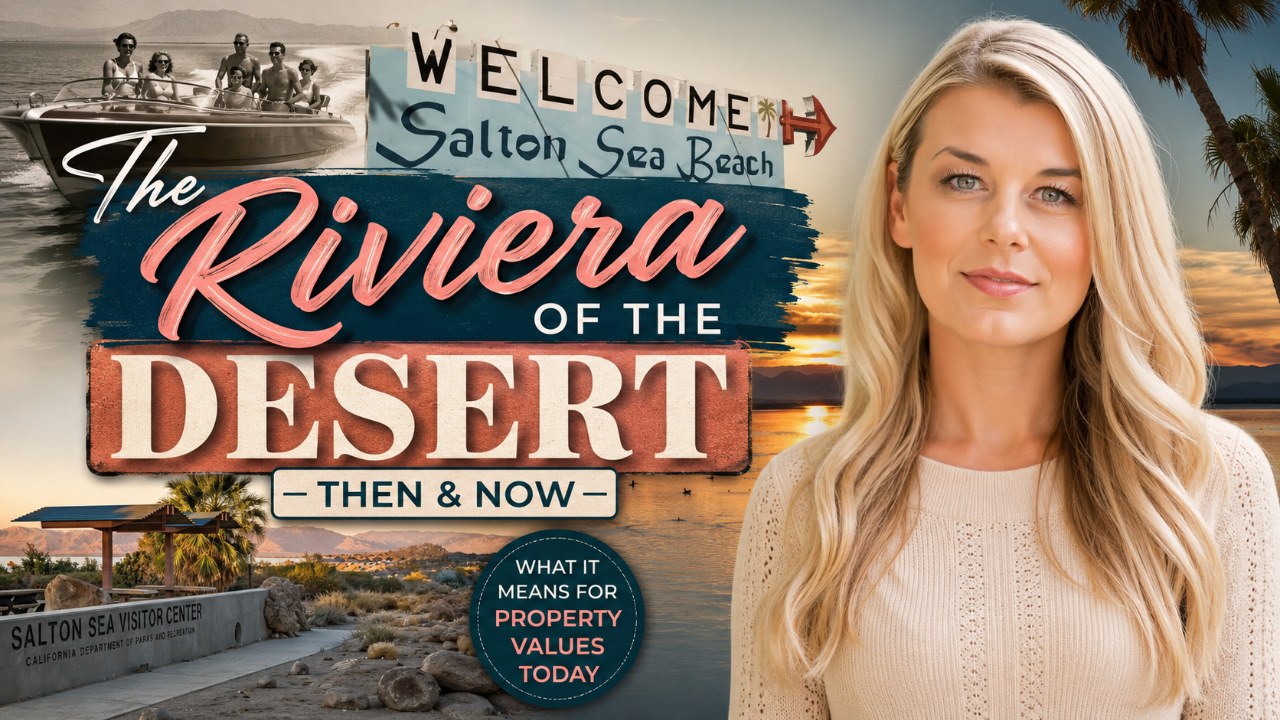
When the Salton Sea Was the Riviera of the Desert — and What It Means for Property Values Today
What does Salton Sea history tell us about property values in the south Coachella Valley today?
The Salton Sea's dramatic arc — from accidental lake to celebrity playground to environmental crisis — is one of the most consequential stories in Coachella Valley real estate history, and understanding it is essential for any buyer or investor looking at south-valley communities near its shores.
It was the summer of 1958, and the North Shore Yacht Club had a waiting list.
Speedboats cut across the glittering water. A young Frank Sinatra had been spotted at a lakeside lounge. The Beach Boys would play here within a few years. The Salton Sea — California's largest lake by surface area — was pulling half a million visitors a year, reportedly more than Yosemite National Park. Real estate developers were platting entire towns along its banks, betting that this shimmering inland sea in the middle of the Sonoran Desert was the next big thing. For a brief, extraordinary moment, they weren't wrong.
Understanding how that story unraveled — and what it left behind — is one of the most important pieces of context you can have if you're considering property anywhere in the south end of the Coachella Valley.
How a Colorado River Mistake Became a Celebrity Destination
The Salton Sea didn't exist until 1905. The Colorado River had been diverted into a series of irrigation canals to feed the newly cultivated Imperial Valley, and in the spring of that year, a series of engineering failures sent the river's entire flow pouring into the Salton Sink — a dry lakebed sitting 227 feet below sea level. For nearly two years, engineers couldn't stop it. By the time the breach was finally sealed in 1907, a 35-mile-long, 15-mile-wide lake had been born where there had been desert.
What followed was one of the stranger second acts in California history. The lake stabilized, fed by agricultural runoff from the Imperial Valley. By the 1920s and '30s, it had attracted fishermen and curious day-trippers from Palm Springs. By the 1950s, developers had caught on in a serious way.
Salton Sea Beach, Bombay Beach, Desert Shores, and North Shore were platted and marketed as resort communities. The North Shore Yacht Club — designed in 1959 by modernist architect Albert Frey, one of the same visionaries shaping Palm Springs' mid-century identity — became the social hub of the scene. State and federal money poured in to stock the lake with corvina, tilapia, and croaker, turning it into a legitimate sportfishing destination. Property sold fast. The Salton Sea's story was, for one shining decade, indistinguishable from the broader Palm Desert-era boom that was transforming the entire Coachella Valley into a resort economy.
The Long Decline — and the Environmental Reckoning
The cracks started showing in the 1970s. With no natural outlet, the Salton Sea had always been accumulating the salts and agricultural chemicals carried in by runoff. Salinity levels — already higher than the Pacific Ocean — kept climbing. The fish populations that had sustained the resort economy began dying off in mass events that left beaches carpeted in carcasses. The smell became notorious. The celebrities moved on. The yacht clubs closed.
What followed was a slow-motion crisis that accelerated dramatically in the 2000s, when a water transfer agreement sent less agricultural runoff into the lake, dropping water levels and exposing a dry, dusty lakebed rich in selenium, arsenic, and fine particulate matter. The wind does what desert wind always does — it picks it up and moves it. Communities like Mecca, Thermal, and the communities near North Shore, many of them low-income agricultural communities, have faced some of the worst air quality in California as a result.
Today, the Salton Sea is a live policy debate at the state level. California's Salton Sea Management Program has committed to building dust-suppression projects — covering exposed lakebed with vegetation and shallow water projects — but the scale of the problem and the pace of the solution remain deeply mismatched. Restoration advocates, environmental scientists, and geothermal energy developers (the area sits atop significant lithium deposits, which has added a new economic dimension to the conversation) are all active stakeholders. The story isn't over. But it isn't clean, either.
Salton Sea History and Property Values: What the South Valley Looks Like Today
Here's where the history becomes directly relevant to your real estate decisions.
The communities closest to the Salton Sea — North Shore, Mecca, Bombay Beach, Salton City (on the western shore, in Imperial County) — have some of the most dramatically distressed property values in California. Homes that sold for tens of thousands of dollars during the resort era sit vacant or near-abandoned. Some sell today for under $50,000, occasionally far less. That low price point attracts a certain kind of speculative buyer, and it's worth being clear-eyed about what you're speculating on: uncertain air quality, limited municipal services, a long timeline for any meaningful restoration, and significant environmental exposure risk.
That's not a reason to never look — but it is a reason to look carefully and honestly.
Slightly further north, communities like Indio and Coachella (already linked) sit close enough to the south valley to feel the gravitational pull of these issues — particularly air quality on high-wind days — but far enough removed that they function as normal Coachella Valley real estate markets with standard demand drivers: Coachella Festival proximity, affordability relative to Rancho Mirage or Indian Wells, and access to the valley's broader employment base.
For buyers looking at La Quinta or south Palm Desert — the closest "core" valley cities to the Salton Sea — the practical impact on property values is minimal and largely indirect. What you may notice is the occasional dust event on a bad wind day, and ongoing conversations in Riverside County planning circles about long-term growth in the south valley.
The genuinely interesting wildcard is lithium. The Salton Sea sits above a geothermal brine resource that may contain one of the largest lithium deposits in North America. If that extraction industry develops at scale — and major energy companies and the state of California are actively working toward it — it could mean jobs, infrastructure investment, and economic activity in a part of the valley that has seen very little of any of those things for fifty years. That's speculative, but it's not baseless speculation.
What This Means For You
• South-valley bargain properties require serious due diligence. Before buying near the Salton Sea's shores, research current air quality data (the South Coast AQMD publishes monitoring data for the region), verify what infrastructure and municipal services actually exist, and talk to a local agent who knows the area's specific conditions — not just the price point.
• The Salton Sea's story is a powerful reminder that resort-era valuations can evaporate. Communities that were once marketed as "the next big thing" can decline dramatically when environmental or economic fundamentals shift. That's a useful lens for evaluating any speculative south-valley purchase today.
• The lithium opportunity is real but long-timeline. If the Salton Sea lithium extraction industry develops, nearby communities could benefit — but "could" and "eventually" are doing a lot of work in that sentence. Don't buy today banking on that outcome in the next five years.
• Core valley cities are not significantly impacted. If you're buying in Cathedral City, Desert Hot Springs, Palm Springs, Palm Desert, Rancho Mirage, Indian Wells, or La Quinta, the Salton Sea's challenges are background context — interesting historically, but not a material factor in your purchase decision.
The rise and fall of the Salton Sea is one of the great California stories — glamour, hubris, environmental consequence, and a messy, unresolved attempt at redemption. It's also a grounding story for anyone who buys real estate in the desert. Markets reflect more than square footage and pool size. They reflect water, air, infrastructure, and the long arc of decisions made decades before you arrived. Knowing that history doesn't make the south valley a bad place to buy — but it makes you a smarter buyer, which is always the goal.
Ready to make your move in the Coachella Valley? Reach out to Shana Gates at Craft & Bauer. Contact Shana →
Frequently Asked Questions
Does the Salton Sea affect property values in Palm Springs or Palm Desert?
For most buyers in Palm Springs or Palm Desert, the Salton Sea has little direct impact on property values — these cities are 30 to 50 miles from the lake's shores and operate in a fully separate real estate market with their own demand drivers. On high-wind days, some south valley residents may notice reduced air quality, but it is not a material factor in pricing or buyer demand in the core Coachella Valley cities.
Is it safe to buy property near the Salton Sea today?
That depends on how close and what your goals are. Properties in communities like North Shore, Mecca, or Bombay Beach carry real considerations: air quality from exposed lakebed dust, limited municipal services, and uncertain long-term restoration timelines. Anyone seriously considering a purchase in those areas should review current air quality monitoring data from the South Coast Air Quality Management District and consult with a local agent who specializes in that specific submarket before making a decision.
Could the Salton Sea's lithium deposits increase nearby property values?
It's possible, but it's a long-horizon bet. The Salton Sea sits above geothermal brine that may contain significant lithium reserves, and major energy companies and California state agencies are actively exploring extraction. If that industry develops at scale, it could bring jobs and infrastructure investment to the south valley. However, commercial lithium production from the area is still years away from any meaningful scale, and property decisions shouldn't be based on that outcome alone.