
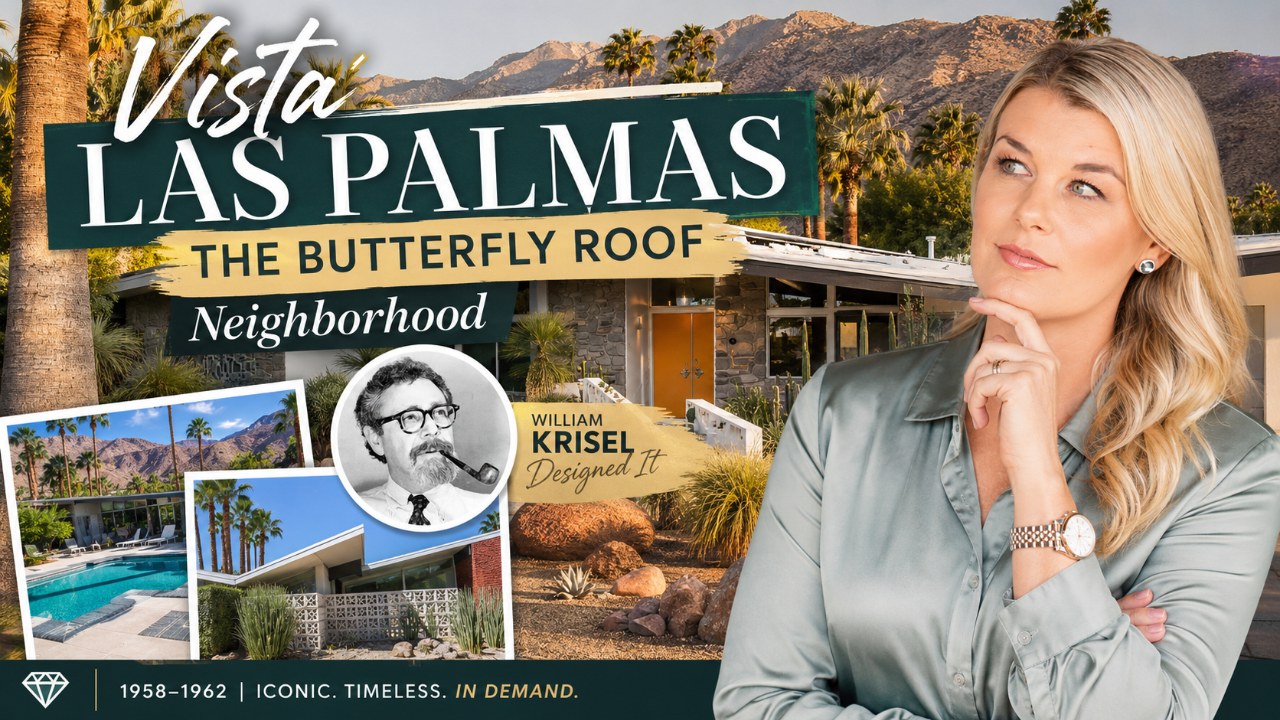
Vista Las Palmas: The Palm Springs Neighborhood Where Krisel Built the Butterfly Roof
What makes Vista Las Palmas one of the most coveted mid-century modern neighborhoods in Palm Springs?
Vista Las Palmas is a north Palm Springs tract developed by Alexander Construction between 1958 and 1962, where architect William Krisel refined the butterfly roof into its most iconic form — creating homes so architecturally distinctive that they still regularly sell for $1.2M to $2M today.
The year is 1958. Bob and Helene Alexander — the father-and-son-led construction company that had already been stamping the Palm Springs desert floor with inexpensive, modernist tract homes — turned their attention to a new parcel north of downtown, tucked between Vista Chino to the south and Racquet Club Road to the north. They brought back their collaborator, architect William Krisel of Palmer & Krisel, and gave him room to push the design further than he had in any previous Alexander tract. What Krisel delivered in Vista Las Palmas wasn't just another affordable postwar subdivision. It was a refinement — the place where the butterfly roof stopped being an experiment and became a signature.
What Krisel Actually Built Here — and Why It Was Different
The butterfly roof, if you haven't stood beneath one, is exactly what it sounds like: two roof planes angled downward toward the center rather than upward into a peak, creating a dramatic V-shape that catches the eye from the street. Krisel used it in earlier Alexander tracts, but at Vista Las Palmas he applied it with greater consistency and paired it with folded-plate roof variations that added geometric complexity to the streetscape. The result was a neighborhood that looked like nothing else in America at the time — and still doesn't.
Beyond the roofline, Krisel's Vista Las Palmas homes featured floor-to-ceiling glass walls that dissolved the boundary between indoors and desert, post-and-beam construction that eliminated the need for load-bearing interior walls, and wide overhanging eaves that shaded those glass walls from the brutal summer sun. These weren't aesthetic choices made in a vacuum — they were design solutions to the specific challenges of desert living. The deep overhangs cut direct sun in summer while allowing lower winter light to warm the interiors. The open floor plans captured cross-ventilation before central air conditioning was standard. Krisel was solving problems, and the solutions happened to be beautiful.
The homes were built on modest lots and sold to middle-class buyers — schoolteachers, business owners, Hollywood workers. Kirk Douglas purchased the home at 515 W Via Lola, which tells you something about the neighborhood's appeal: it attracted serious architecture enthusiasts from the moment it was finished.
How Vista Las Palmas Stayed Intact When So Many MCM Tracts Didn't
Drive through other mid-century subdivisions across the Coachella Valley and you'll find the original bones buried under stucco additions, conventional rooflines, and ranch-style remodels. Vista Las Palmas largely avoided that fate, and it wasn't an accident. The neighborhood association and a set of design covenants have worked to preserve the architectural character of the tract for decades. Owners who want to modify exteriors face scrutiny, and that friction has kept the streetscape unusually coherent.
The broader preservation movement helped, too. As mid-century modern architecture surged in cultural appreciation — accelerated by Modernism Week, which draws tens of thousands of visitors to Palm Springs each February — Vista Las Palmas became recognized not just locally but nationally as a significant example of postwar residential design. That recognition created a self-reinforcing cycle: buyers who care deeply about architectural integrity compete for homes here, which drives prices up, which makes it economically rational for owners to restore rather than remodel.
The result today is a neighborhood where you can walk the streets and see Krisel's original vision largely intact — the butterfly rooflines catching the afternoon light, the glass walls glowing at dusk, the carports angled just so toward the street. It's a living museum that people actually live in.
Vista Las Palmas Palm Springs Today: What Buyers Are Actually Paying
Homes in Vista Las Palmas currently trade in the $1.2M to $2M range, with fully restored, architecturally significant examples at the top of that range and original-condition homes with more work needed at the lower end. That's a meaningful premium over comparable square footage elsewhere in Palm Springs — buyers are paying for the address, the architectural pedigree, and the preservation covenant that protects their investment from a neighbor's ill-advised remodel.
The neighborhood also sees strong vacation rental activity. Palm Springs requires a short-term rental permit and collection of Transient Occupancy Tax (TOT), but Vista Las Palmas homes are consistently among the most in-demand rental properties in the city — guests specifically search for Krisel-designed homes and butterfly-roof architecture. That demand supports purchase prices and gives owner-investors a credible income story alongside the lifestyle purchase.
If you're researching the Palm Springs mid-century modern market more broadly, it's worth understanding how Vista Las Palmas fits into the larger landscape of Alexander Construction tracts — from the Twin Palms neighborhood to the Movie Colony — each with its own design variations and price positioning.
Why It Still Matters Today
The story of Vista Las Palmas isn't just architectural history. It's the story of what happens when design quality is taken seriously and then protected over time. Krisel built homes that were meant to be affordable and democratic — and sixty-plus years later, they've become some of the most valuable residential properties in the Coachella Valley. That's what genuine design integrity does to real estate over a long enough timeline.
What This Means For You
• Buyers targeting Vista Las Palmas should expect to compete — well-restored Krisel homes here move quickly during snowbird season (November through April), and inventory is thin by nature of the tract's finite size.
• Architectural condition matters enormously to price. A home with original Krisel details intact — exposed beams, original terrazzo, period-correct hardware — will command a measurable premium over one that's been conventionally updated.
• Vacation rental income is a real part of the calculus. Palm Springs STR permits are available in this neighborhood; confirm permit availability and current TOT rates with the City of Palm Springs before closing.
• The design covenants cut both ways. They protect your investment by keeping the neighborhood intact — but they also constrain what you can do with an exterior remodel. Read the CC&Rs carefully before making an offer.
Whether you're drawn to Vista Las Palmas as a primary home, a second home, or a high-design vacation rental, you're buying into one of the most architecturally coherent mid-century neighborhoods in the United States. That's not marketing language — it's what sixty years of preservation and architectural scholarship have confirmed.
Ready to make your move in the Coachella Valley? Reach out to Shana Gates at Craft & Bauer. Contact Shana →
Frequently Asked Questions
Where exactly is Vista Las Palmas located in Palm Springs?
Vista Las Palmas sits in north Palm Springs, bordered roughly by Vista Chino to the south and Racquet Club Road to the north. The neighborhood is easily accessible from downtown Palm Springs and sits at the base of the San Jacinto Mountains, which form its dramatic western backdrop.
Did William Krisel design all of the homes in Vista Las Palmas?
Krisel of the firm Palmer & Krisel designed the majority of the Alexander Construction tract homes in Vista Las Palmas between 1958 and 1962, including the homes featuring the signature butterfly and folded-plate roofs. Not every structure in the broader neighborhood is a Krisel-Alexander home, so buyers specifically seeking his work should confirm the design provenance of individual properties before purchasing.
Are Vista Las Palmas homes good candidates for short-term vacation rentals?
Palm Springs permits short-term rentals with a city-issued STR permit and requires collection of Transient Occupancy Tax (TOT). Vista Las Palmas homes — particularly those with original Krisel architecture intact — are among the most sought-after vacation rental properties in the city, with guests specifically seeking mid-century modern design. Buyers should verify current permit availability and any applicable caps directly with the City of Palm Springs prior to purchase.