
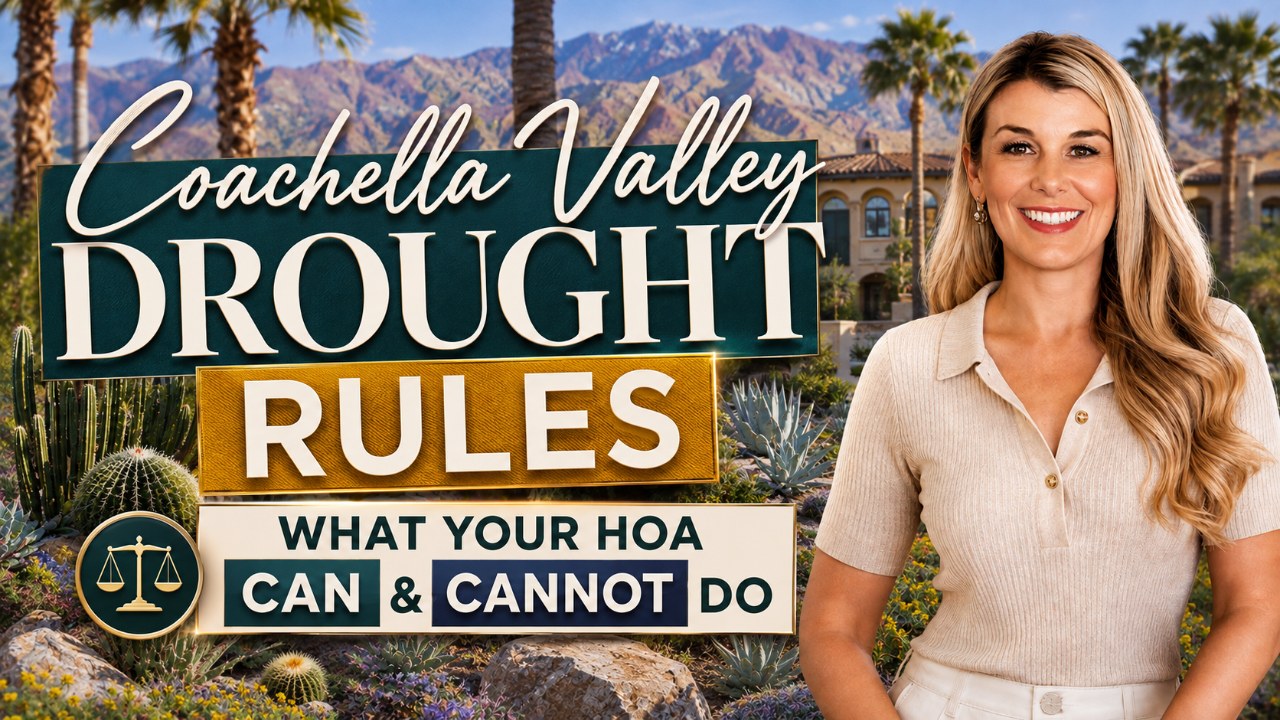
Your HOA Cannot Penalize You for Conserving Water — Here's What Coachella Valley Homeowners Need to Know
Can your HOA fine you for cutting back lawn watering or replacing your grass with drought-tolerant plants during a drought emergency?
No — under the Davis-Stirling Act, California HOAs are legally prohibited from fining homeowners for reducing irrigation or removing lawns during a declared drought emergency. And those protections can extend even after the drought ends.
This is one of the most empowering — and most overlooked — pieces of real estate law for homeowners across the Coachella Valley. If you live in an HOA-governed community (and many of us do), understanding your rights around the Water Conservation Portal - Emergency regulations could save you real money and real stress.
What the Davis-Stirling Act Actually Says About Drought Emergencies
The Davis-Stirling Common Interest Development Act is the governing law for HOAs in California, and it includes clear language protecting homeowners when a drought emergency is declared — either by the Governor or a local government authority.
During a declared drought emergency, your HOA cannot:
• Fine you for reducing or stopping watering of your lawn or vegetation
• Prohibit you from removing your lawn and replacing it with water-wise, low water-using plants
• Force you to reverse water-efficient landscaping changes once you've made them — even after the drought emergency ends
That last point matters especially here in the desert. If you make the investment in xeriscaping or drought-tolerant ground cover during a drought emergency, your HOA cannot come back later and demand you replant turf. The Water Conservation Portal - Emergency framework was designed precisely to prevent that kind of penalty.
Why This Is Such a Big Deal for Desert Homeowners
In Palm Springs, Palm Desert, Rancho Mirage, and communities throughout the valley, HOA-governed properties are the norm — not the exception. Gated communities, golf course neighborhoods, and condo complexes all operate under CC&Rs that can feel intimidating to push back against. Many homeowners assume the HOA has the final word on landscaping. The law says otherwise.
Beyond the legal protection, there's a strong financial case for water-wise landscaping in our climate. With summer temperatures regularly reaching 110°F and water costs continuing to rise, replacing thirsty turf with native desert plants, decomposed granite, and drought-tolerant ground cover can meaningfully reduce your monthly utility bills. It also increases your property's appeal to buyers who understand the long-term cost of maintaining a green lawn in the Sonoran Desert.
California law also reinforces this at the community level: HOAs cannot broadly prohibit the use of low water-using plants as a group, or as a replacement for existing grass. The Water Conservation Portal - Emergency rules are part of a broader state framework pushing communities toward sustainability — and homeowners have legal standing to act on it.
What This Means For You
• HOA fines for reduced watering are not enforceable during a declared drought emergency. If you receive a notice, you have legal grounds to dispute it under the Davis-Stirling Act.
• You can remove your lawn. Replacing grass with low water-using plants is protected by state law — your HOA cannot block it outright.
• Drought-emergency landscaping changes are permanent. Once installed during a declared emergency, your HOA cannot require you to remove water-efficient landscaping after the emergency ends.
• HOAs cannot ban low water-using plants categorically. Even outside a formal drought declaration, California law limits HOA authority to restrict drought-tolerant planting as a class.
If you're thinking about making landscaping changes, document the drought emergency declaration in effect at the time and keep records of your HOA correspondence. A little paper trail goes a long way if disputes arise later.
Whether you're a homeowner looking to cut utility costs, a buyer evaluating HOA communities, or an investor managing properties across the valley, knowing your rights under California's emergency conservation regulations is genuinely useful — and in the desert, it's increasingly relevant. Water is the resource that shapes life here, and the law is on your side when you choose to use less of it.
Ready to make your move in the Coachella Valley? Reach out to Shana Gates at Craft & Bauer — she knows this market inside and out. Contact Shana →
Frequently Asked Questions
Can my HOA fine me for not watering my lawn during a California drought emergency?
No. Under the Davis-Stirling Act, a California HOA is legally prohibited from imposing fines on homeowners who reduce or stop watering their lawns during a drought emergency declared by the Governor or a local government. If you receive a violation notice during a declared emergency, you have legal grounds to contest it.
If I replace my lawn with drought-tolerant landscaping during a drought, can my HOA make me put the grass back afterward?
No — this is one of the strongest protections in the law. Once you install water-efficient landscaping during a declared drought emergency, your HOA cannot require you to remove it or restore turf after the emergency ends. Your investment in xeriscaping or low water-using plants is legally protected going forward.
Can a Coachella Valley HOA ban drought-tolerant or low water-using plants entirely?
No. California law explicitly prohibits HOAs from banning low water-using plants as a group or from preventing them from being used as a replacement for existing grass. While HOAs can apply reasonable aesthetic standards around how such landscaping is installed, they cannot use blanket prohibitions to block water-wise choices outright.
Source: waterboards.ca.gov