
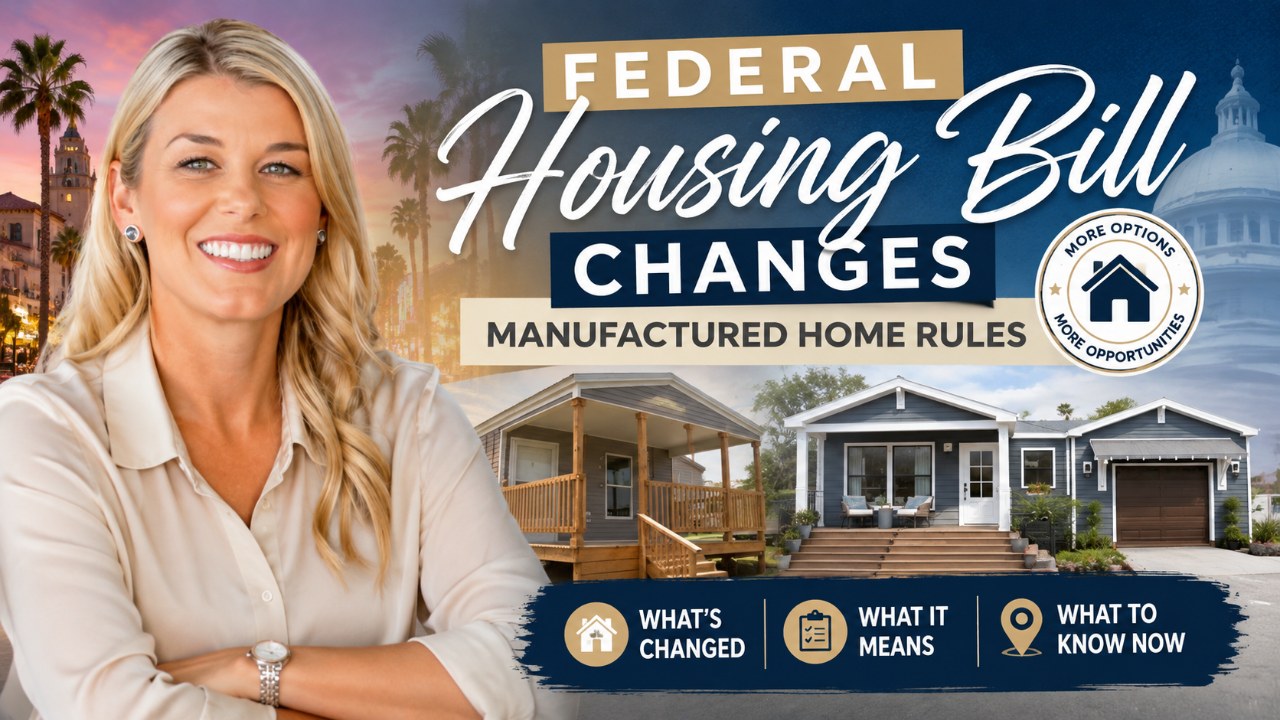
What the New Federal Housing Bill Means for California — and the Coachella Valley
What does the new federal housing bill mean for California homeowners and buyers?
The new federal housing bill removes the permanent chassis requirement for manufactured housing, a decades-old policy change that could expand access to one of the most affordable forms of homeownership in the country — including right here in the Coachella Valley.
What the New Federal Housing Bill Actually Changes
For those outside the policy weeds, the "permanent chassis" requirement has been a fixture of federal manufactured housing rules since the 1980s. Under the old standard, a home had to be built on a permanent steel chassis to qualify for certain federal financing programs. That distinction mattered enormously for buyers seeking conventional or FHA loans on manufactured homes.
What the new federal housing bill does is simple in principle: it removes that chassis requirement. As Rep. Scott Peters (D–San Diego) put it at the bill's press conference, "That relatively minor change will expand access to one of the most affordable forms of home ownership available." Minor in language, potentially significant in practice — particularly in communities where manufactured housing makes up a meaningful share of the housing stock.
Why This Matters in the Coachella Valley
Manufactured and mobile homes are a real part of the housing landscape across the valley. Cities like Desert Hot Springs, Coachella, and Indio have long had concentrations of manufactured housing, and for good reason — these homes can offer entry points into homeownership at price points well below the valley's median. Desert Hot Springs, for example, has some of the most affordable housing in Riverside County, with prices that can dip below $250,000.
If the removal of the chassis requirement makes it easier for lenders to finance manufactured homes — and for buyers to access those loans — it could quietly open doors that were previously closed. Think first-time buyers, buyers on fixed incomes, or anyone priced out of Palm Desert or Palm Springs who still wants to own rather than rent.
That said, the effect in California specifically may be more limited than in other states. California's housing market is not heavily dominated by large corporate investors the way some Sun Belt markets are, which means one key provision of the broader bill — restrictions on institutional investors — is unlikely to reshape the local market dramatically.
Caveats Worth Knowing
Like most federal housing legislation, this bill comes with fine print. A few important notes:
• The investor-restriction provisions define "large" investor as any entity controlling more than 350 single-family homes. Current portfolio holders are not required to divest — the rule applies going forward, not retroactively.
• Exemptions exist for new construction, renovations, and senior housing, so the law's reach is narrower than headlines might suggest.
• State and local zoning rules still govern where manufactured homes can be placed, and California's zoning landscape is complex. A federal financing change doesn't automatically override a city's land-use code.
For Coachella Valley buyers interested in manufactured housing, this is encouraging news — but you'll still want to work with a lender who understands the nuances of manufactured home financing and a REALTOR® who knows which communities and parcels are even eligible.
What This Means For You
• Buyers seeking affordability: The chassis rule change could open up more loan products for manufactured homes in communities like Desert Hot Springs, Coachella, and Indio — worth exploring if you've been priced out elsewhere.
• Current manufactured homeowners: This could improve your home's financing eligibility and, over time, its resale appeal to a broader buyer pool.
• Investors: The institutional investor provisions don't apply retroactively and don't affect smaller portfolios — but stay informed as implementation rules develop.
• Sellers in manufactured home communities: If financing access improves, your buyer pool may grow. That's a meaningful shift in markets where cash-only buyers have historically been the norm.
The Coachella Valley has always had a more diverse housing mix than its luxury reputation suggests. Changes like this one — even incremental ones — have real implications for real people trying to plant roots here. If you're curious how manufactured housing fits into your buying or selling strategy, it's worth a conversation.
Ready to make your move in the Coachella Valley? Reach out to Shana Gates at Craft & Bauer — she knows this market inside and out. Contact Shana →
Frequently Asked Questions
What does the new federal housing bill change about manufactured homes?
The new federal housing bill removes the permanent chassis requirement that has historically been a condition for federally backed financing on manufactured homes. This change, which housing policy advocates have sought since the mid-1980s, could make it easier for buyers to obtain conventional or FHA loans on a broader range of manufactured housing.
Will the new federal housing bill lower home prices in the Coachella Valley?
Not directly — and not quickly. In California, where large corporate investors don't dominate the single-family market the way they do in some other states, the bill's effect on prices is expected to be modest. The more meaningful local impact may be on financing access for manufactured homes in more affordable communities like Desert Hot Springs, Coachella, and Indio.
Does the new federal housing bill affect mobile home parks in California?
The bill's manufactured housing provisions focus on financing eligibility rather than land ownership or park regulation. California has its own mobile home park laws, and local zoning rules still determine where manufactured homes can be sited. Buyers and homeowners in mobile home parks should consult with a knowledgeable local REALTOR® and lender to understand how federal changes interact with state and local rules.
Source: calmatters.org